How to Make Money With a 3D Printer: Realistic Numbers for a Side Hustle
One home printer won't replace a paycheck, but it can pay for itself and bring in steady side income. Here are the ways to earn, and a real craft-fair batch costed from the slicer numbers.
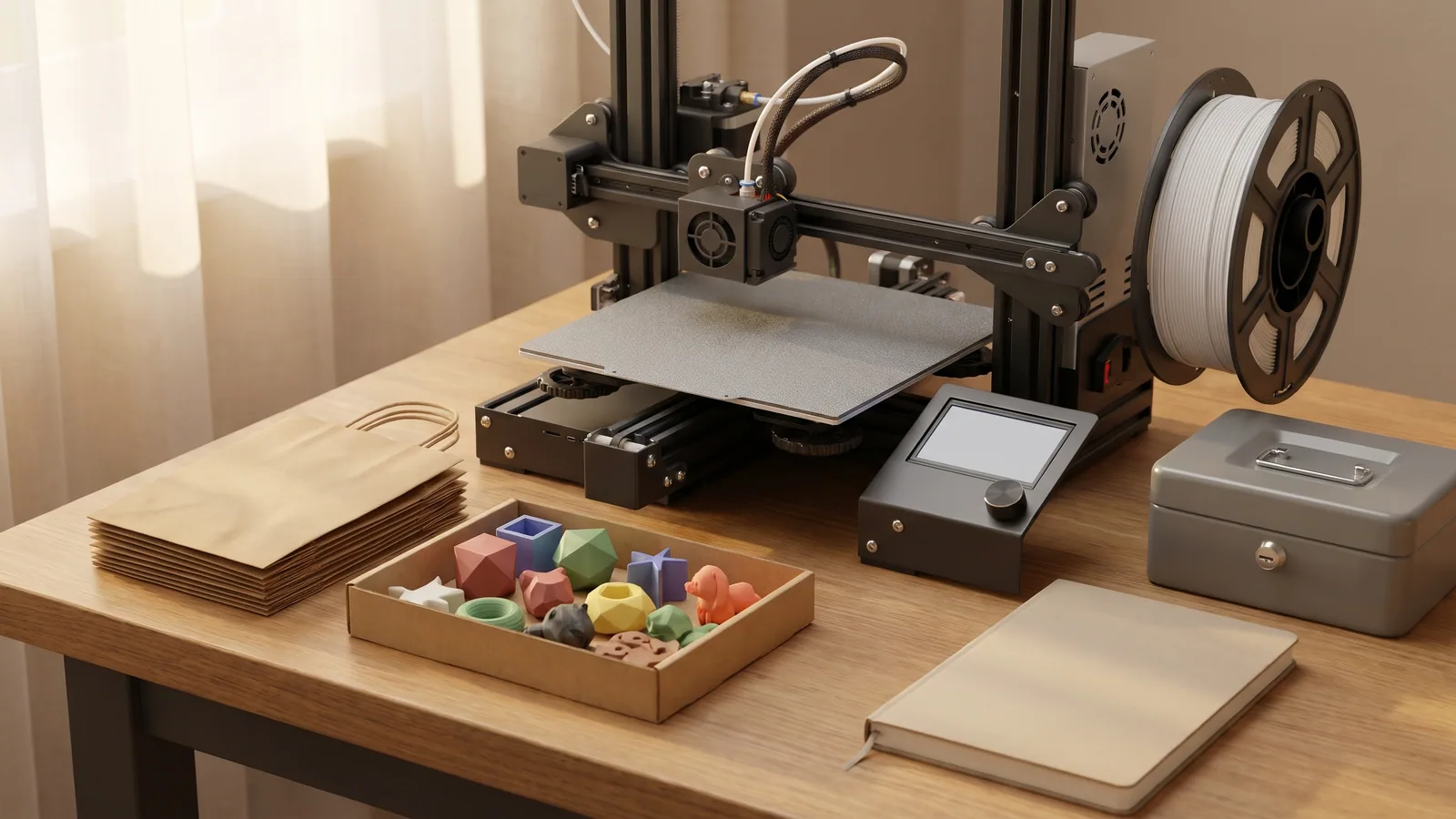
Most "make money with a 3D printer" advice skips the part that decides whether it works: how many hours your printer has in a week, and what each of those hours turns into. One home printer won't replace a paycheck. It can pay for itself and bring in steady side income, as long as you pick small things people want, price in your own time and start printing weeks before you need the stock.
This guide covers the main ways people earn from a home printer, then works through a real batch: a full craft-fair table of 84 items made from four 3MF Labs designs, with every print time and filament weight taken from the slicer estimates in the downloads. Where a number is our assumption (spool price, your hourly rate), we say so, so you can swap in your own.
Can you really make money with a 3D printer?
Yes, but think "side income", not "business that runs itself". The money comes from selling things you print, and three limits shape how much you make:
- Printer hours. A printer makes one plate at a time. A plate of six ornaments takes a couple of hours; a lantern frame takes most of a day. Your printer's week is your stock.
- Your time. The printer runs on its own, but you start every plate, clear it, check the prints, bag them and sell them. On small items your minutes usually cost more than the plastic.
- Demand. A print only earns when someone buys it. What you love printing and what sells at your table aren't always the same thing.
Filament is rarely the problem. A 1 kg spool at $20 (our assumption; prices vary) makes dozens of small items. The people who do well with one printer usually sell low-cost, quick items in batches, and add a few bigger pieces that draw people to the table.
What are the best ways to make money with a 3D printer?
There are five common routes. Most side sellers mix two or three.
| Way to earn | What you sell | Good for | Watch out for |
|---|---|---|---|
| Craft fairs and markets | Finished prints, in person | Seasonal decor, fidgets, earrings, gifts | Table fees and stock you print weeks ahead |
| Your own online shop | Finished prints, shipped | Items that ship small and light | Shipping, packaging and fees eat into small sales |
| Custom and personalized orders | Names, dates, colors on request | Ornaments, name tags, gifts | Extra minutes per order; price them in |
| Local shops and events | Prints on consignment or wholesale | Gift shops, school events, party favors | Lower price per item for volume |
| Your own designs | Files you design yourself | People who model in CAD | Takes design skill and time to build up |
If you sell prints of designs someone else made, check what the license on those files allows. With 3MF Labs designs it's simple: our license lets you sell the physical prints you make, with no limit and no royalty. You can't share, upload or resell the files themselves. Our guide to selling 3D prints covers the rest of the basics.
What 3D prints actually sell?
Things that are cheap to make, quick to print, and fun to pick up. At in-person sales, people buy with their hands: something that wiggles, spins, clicks or glows gets picked up, and things that get picked up get bought. Good one-printer items include:
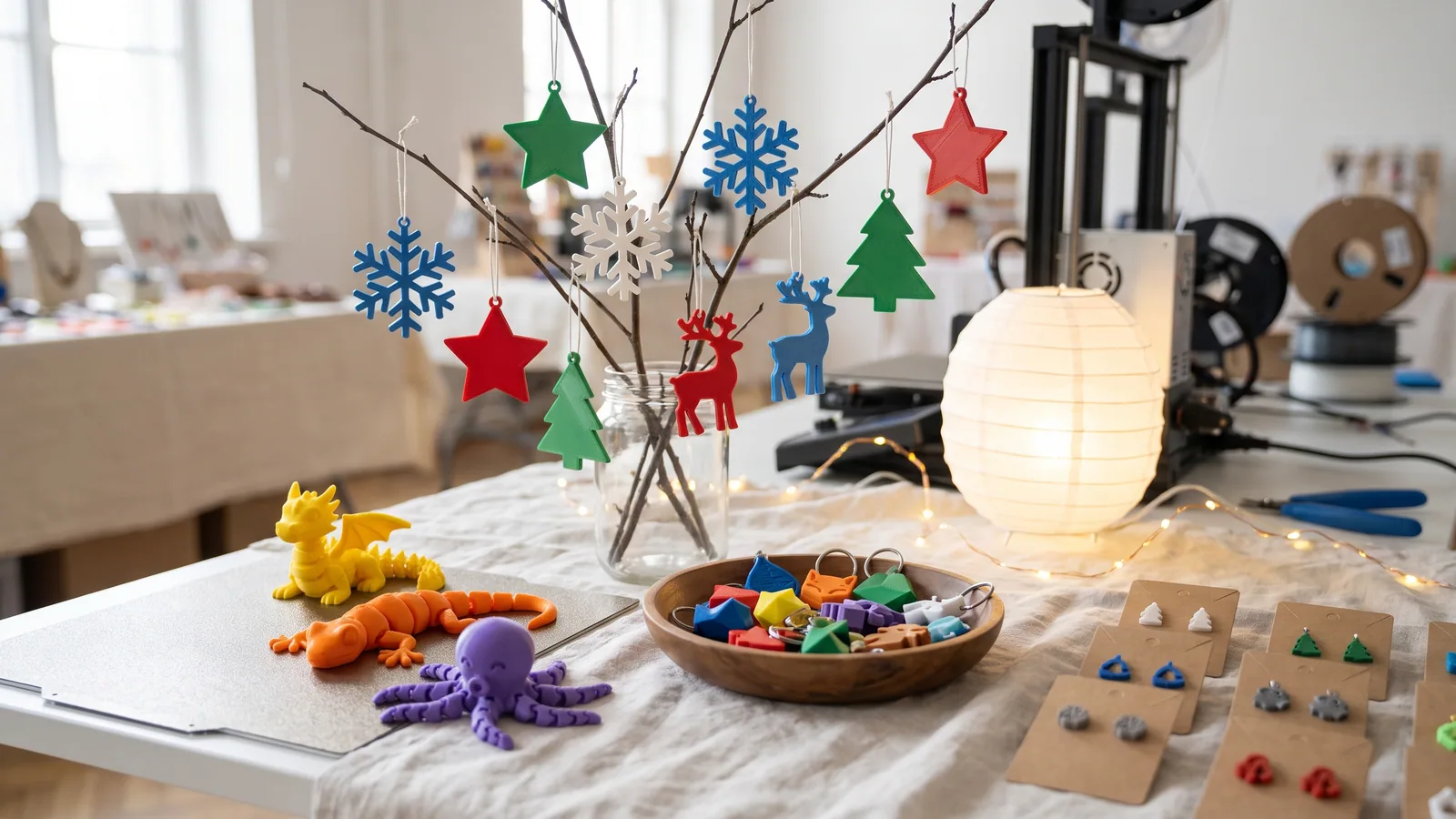
- Flat ornaments and earrings. Minutes each, a few grams, easy to batch. See how to print earrings and add the hooks.
- Flexi animals and fidgets. They print in one piece with no assembly. Our print-in-place guide explains how to print them so the joints move.
- Something that lights up. A tealight house or lantern on the table, lit with a battery LED, draws people from across the room.
- Useful things. Stands, holders and organizers sell all year, not just at the holidays.
For a longer list with print times and filament costs for each item, see 3D prints that sell at holiday craft fairs.
A real example: what does a craft-fair table cost to print?
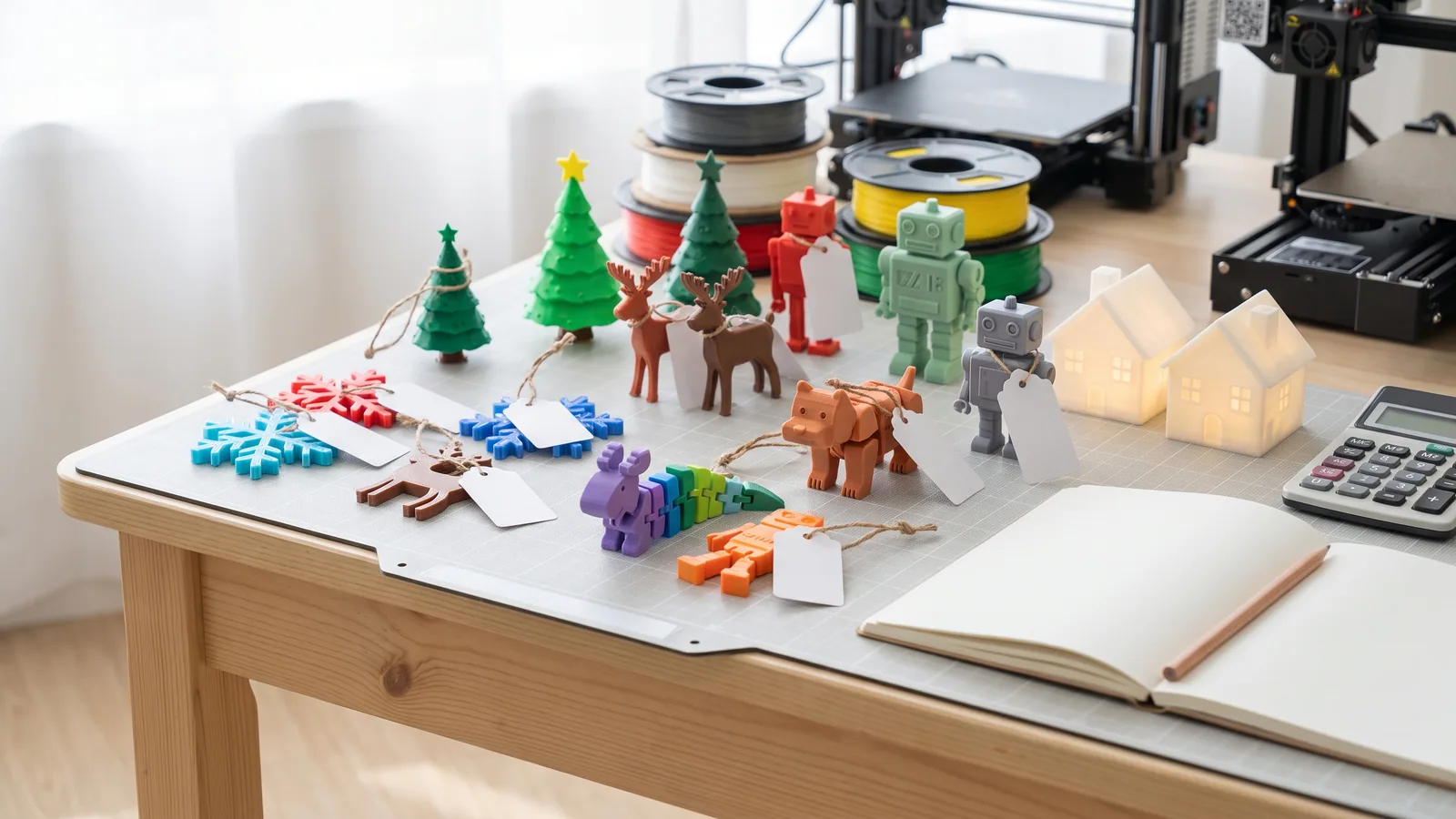
Here's a realistic first table for a holiday fair, made on one printer from four designs. The print times and grams are the slicer estimates saved in each download, printed in one color:
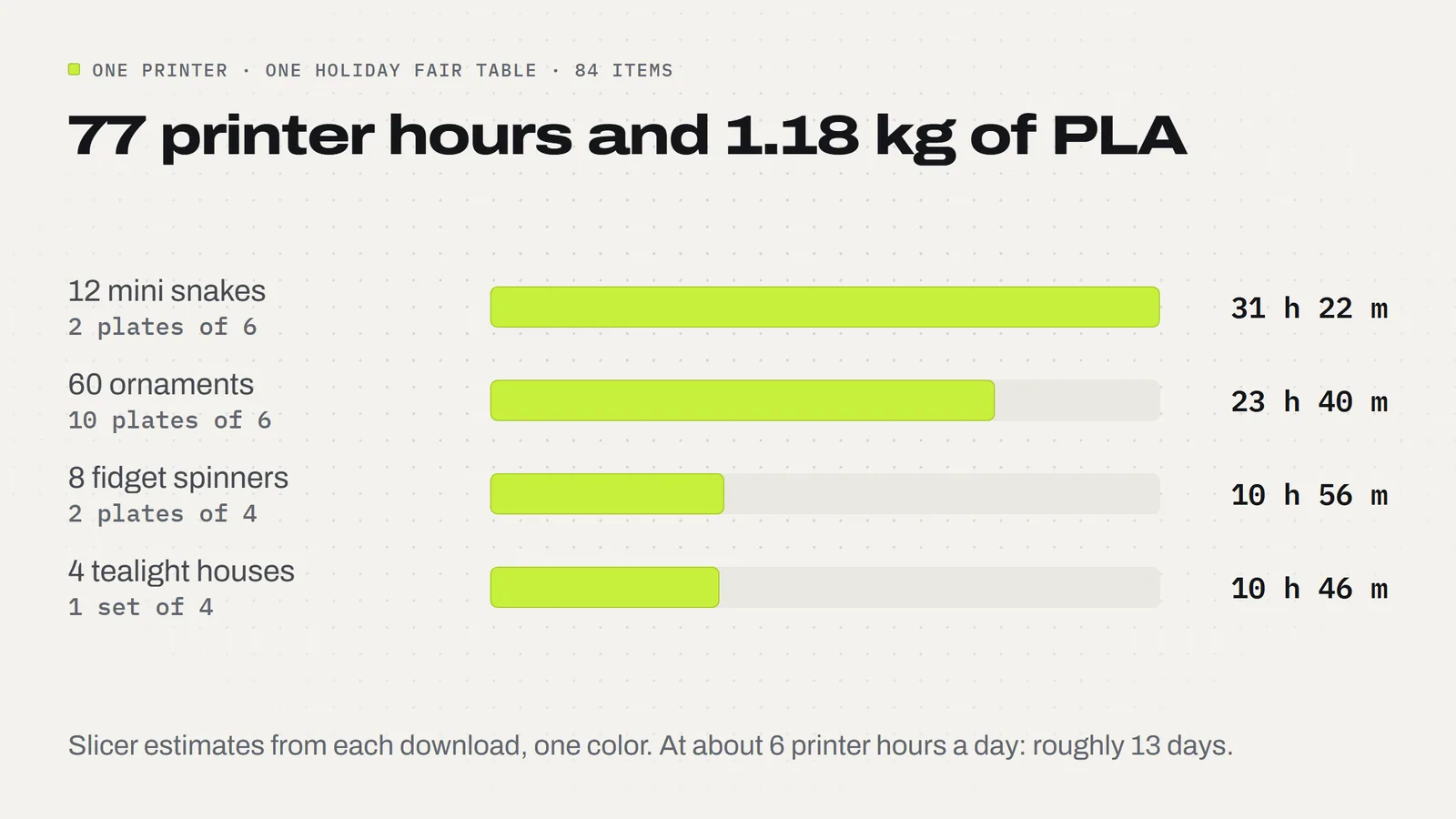
- 60 ornaments from the Christmas Ornament Set: 10 plates of six, each plate 2 h 22 min and 30.74 g.
- 12 mini snakes from the Peppermint Snake: 2 plates of six, each plate 15 h 41 min and 138 g.
- 8 spinners from the Snowflake Fidget Spinner: 2 plates of four, each plate 5 h 28 min and 147 g.
- 4 glowing houses from the Village Tealight Houses: one full set, 10 h 46 min and 299.54 g.
That's 84 items, about 77 printer hours and 1.18 kg of PLA. The filament comes to about $24. The hours are the real constraint: if your printer runs about 6 hours a day around your life, this table takes roughly 13 days to print. Start two to three weeks before the fair, not the weekend before.
How much does it cost to run a 3D printing side hustle?
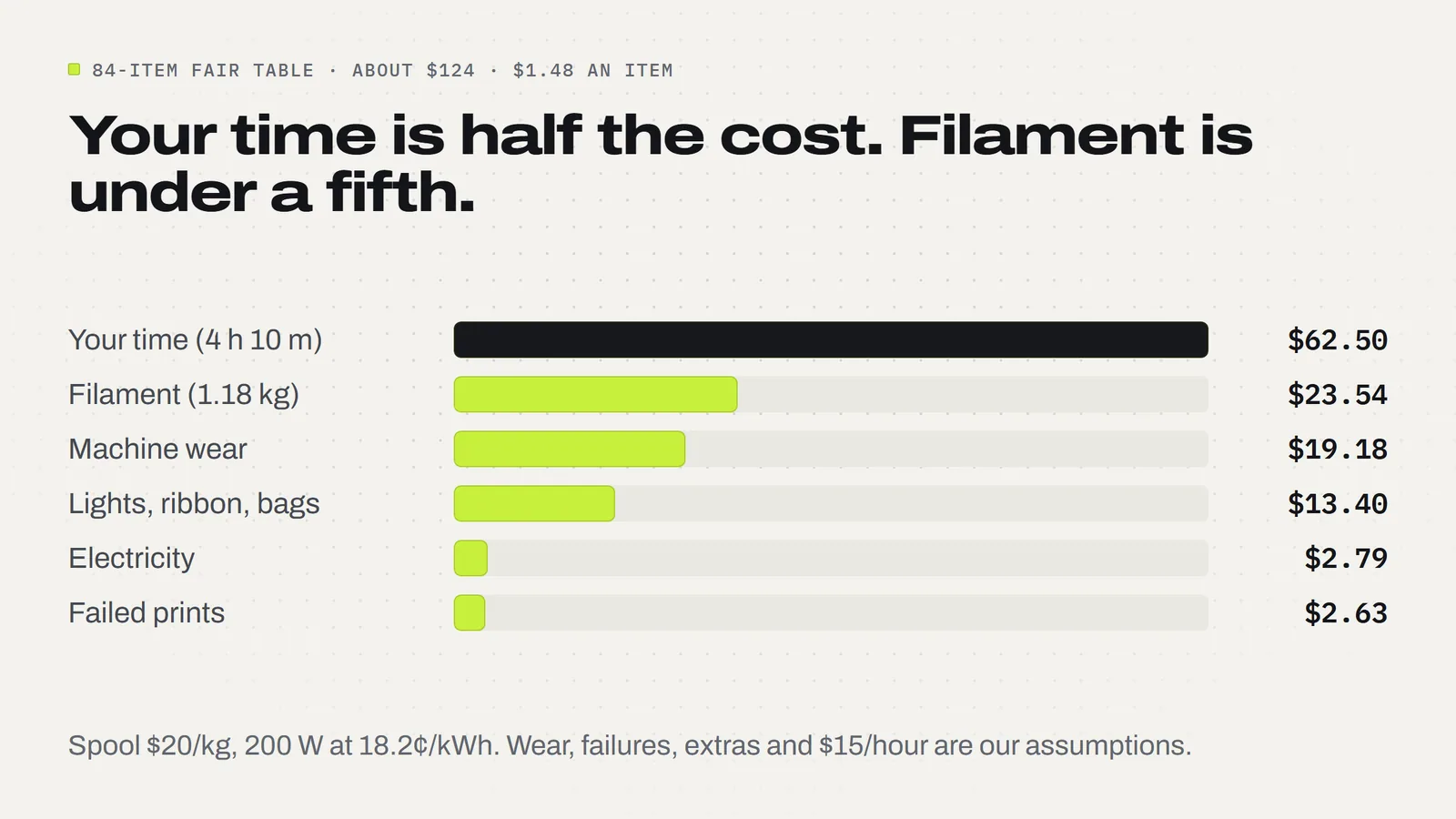
Run the same table through the cost formula from our pricing guide. Filament at $20 a kilogram, a printer drawing about 200 watts at 18.2 cents per kilowatt-hour, 25 cents per printer hour for wear and 10% for failed prints. The last three are our assumptions, so change them to match your printer and your bill.
- Filament: 1,176.94 g = $23.54
- Electricity: 76.7 hours at 3.6 cents = $2.79
- Machine wear: 76.7 hours at 25 cents = $19.18
- Failed prints: 10% of filament and power = $2.63
- Extras: four LED tealights, 60 ornament ribbons and 84 bags = $13.40
- Your time: about 4 hours 10 minutes of clearing plates, checking and bagging, at $15 an hour = $62.50
Total: about $124 for 84 items, or $1.48 each on average. Half of that is your time. Notice that the plastic, the thing most people worry about, is under a fifth of it.
Then there's the one-time cost of starting: the printer itself, a few spools in your colors, bags and a table display. Fair table fees and online selling fees vary too much to give a number here, so take those from your own events and accounts and add them to the list.
Is 3D printing profitable as a side hustle?
It can be, if your prices cover all of those costs and leave something over. Using the pricing guide's approach, a $1.48 average cost means a floor of about $3 an item at twice cost. Where you price above that depends on what similar handmade items sell for at your fair; nobody can tell you that number except your market.
A few things decide whether the hours turn into profit:
- Batch everything. Our Peppermint Snake shows why. Two minis take 6 h 23 min (3 h 12 min each); six on one plate take 15 h 41 min (2 h 37 min each). Fuller plates mean fewer starts and fewer clears, which saves your time too.
- Print one color where you can. Full color with a multi-material system takes far longer. Our AMS guide shows a keychain going from 1 h 40 min in one color to 10 h 11 min in full color.
- Count your time honestly. If the formula without your time looks great, you're probably underpaying yourself.
- Track what sells. After your first fair, print more of what went and drop what didn't.
- Let the printer work while you sleep. Long plates like the snakes are best started at night; short ornament plates fit between other jobs during the day.
How much money can you make with one 3D printer?
Less than the videos suggest, more than nothing. Real numbers depend on your prices, your fairs and how many hours your printer runs, so we won't give you an income figure we can't back up. What you can work out for yourself is your ceiling: printer hours a week, divided by the hours per item, times your profit per item.
Using the table above, 77 printer hours made 84 items. If your printer averages 40 hours a week, that's about half of this table every week. Multiply by your own profit per item and you have a realistic weekly number. If that number is too small, the usual next steps are a higher-value item on the table, fewer full-color prints, or a second printer once the first one is busy every day.
How do you start a 3D printing side hustle?
- Get comfortable printing first. If you're new, our Bambu Studio for beginners guide walks through opening a ready-made project and printing it in five steps.
- Pick five to eight designs that are quick, cheap and fun to pick up, plus one that lights up or moves.
- Do a test plate of each to check fit, color and time on your printer before you print stock.
- Work out the cost of each item with the pricing formula, and set a floor price.
- Book one small event or open a small shop, and see what sells before printing more.
Every 3MF Labs design downloads as a ready-to-print 3MF project with the plate, colors and settings already saved, plus STL files for any other slicer. If you're not sure what that means, what a 3MF file is explains it in a few minutes.
Do you have to pay taxes on 3D printing side income?
In the U.S., yes, even if it's a hobby. The IRS Taxpayer Advocate Service says hobby income still has to be reported on your tax return, and that things like keeping good records, putting in significant time and intending to make a profit point toward it being a business instead. Which one you are changes how you report it. Keep a simple record of sales and costs from day one, and ask a tax professional if you're not sure. This isn't tax advice, just a reminder that the money counts.
The short version: pick small, quick designs, batch them, price in your time, and start printing two to three weeks before you sell. Browse every 3MF Labs design; the license lets you sell the prints you make.
Designs from this guide
 $3.79
3ML-021 · Ornament set
Christmas Ornament Set
Six flat layered tree ornaments with bold black outlines: a snowflake, a snowman, a candy cane, a gingerbread man, a Christmas tree and a blank name banner you personalize. STL + 3MF · 8.7 MB View model $3.79
3ML-013 · Flexi snake
Peppermint Snake
A wiggly snake made of peppermint candies, with black eyes and a red tongue. It prints in one piece, already joined, so there's nothing to put together. STL + 3MF · 23 MB View model $2.49
3ML-067 · Fidget spinner
Snowflake Fidget Spinner
A six-armed snowflake that spins around its centre hub. It prints in place in one piece: no metal bearing, no assembly. STL + 3MF · 8.2 MB View model $3.79
3ML-025 · Tealight houses
Village Tealight Houses
Four snowy little village houses that glow: a red cottage, an ivory church, a green shop and a gingerbread house, each with a lift-off snow roof over a battery LED tealight. STL + 3MF · 14 MB View modelQuestions
Can you make money with a 3D printer at home?
Yes, as side income. Most home sellers make money by printing small, quick items in batches, such as ornaments, earrings, flexi toys and fidgets, and selling them at craft fairs, online or to order. One printer is limited by its hours, so the money grows with how full you keep the printer and how well you price.
Is 3D printing a profitable side hustle?
It can be, if your prices cover filament, electricity, machine wear, failed prints, extras and your own time. In our 84-item fair example the average cost is about $1.48 an item, and half of that is time. Price above twice your cost and check what similar handmade items sell for where you sell.
What sells best when you 3D print to sell?
Cheap, quick items that are fun to pick up sell best in person: things that wiggle, spin, click or glow. Flat ornaments, earrings, flexi animals, fidget spinners and a lit tealight house or lantern on the table are good one-printer choices. Useful stands and holders sell all year.
How much does it cost to start selling 3D prints?
After the printer, the running costs are small. Our 84-item fair table uses 1.18 kg of PLA, about $24 at $20 a spool, plus about $2.79 of electricity. The bigger costs are machine wear, extras like bags and lights, and your time, which brought our total to about $124. Add table and selling fees from your own events.
How long does it take to print stock for a craft fair?
Longer than most people think. Our 84-item table of ornaments, mini snakes, spinners and tealight houses takes about 77 printer hours. At about 6 printer hours a day that's roughly 13 days, so start printing two to three weeks before the fair.
Can I sell prints of designs I bought?
It depends on each design's license, so check it. With 3MF Labs designs, the license lets you sell the physical prints you make with no limit and no royalty. You may not share, upload, resell or give away the files themselves or remixes of them.
Do I need a multicolor printer to make money?
No. Many good sellers print in one color, or use a pause and a filament swap for simple two-color pieces. Full color also takes much longer: our Chattering Nutcracker takes 1 h 40 min in one color and 10 h 11 min in full color, which matters when printer hours are your limit.
Do I have to pay taxes on 3D printing income?
In the U.S., yes. The IRS Taxpayer Advocate Service says hobby income still has to be reported on your return, and running it like a business, with records, real time and a profit goal, points toward it being a business instead. Keep records from day one and ask a tax professional if you're unsure.
Sources
Filed under Selling your prints