3D Prints That Sell at Holiday Craft Fairs (With Real Print Times and Filament Costs)
The prints that fit a craft fair table are cheap to make, quick to batch, easy to understand and fun to pick up. Here are the five kinds worth printing, with real hours, grams and filament cost for each.
A craft fair table is a small shop with a strange rule: you have about three seconds of a stranger's attention, and most of them have five or ten dollars in mind. The 3D prints that do well there are the ones that fit that moment. They're cheap to make, quick to print in quantity, easy to understand at a glance, and fun to pick up. This guide goes through the kinds of prints that fit, with real print times and filament weights for each, so you can plan what to run on the printer between now and your first holiday fair.
Every number below comes from our own designs, sliced in Bambu Studio for a Bambu Lab P2S with ordinary PLA, and every design mentioned is live on our designs page. Each one downloads as a print-ready 3MF project (plates, colors and settings already saved) plus STL files for any other slicer. If "3MF" is new to you, our plain-English guide to 3MF files explains it in a few minutes.
What 3D prints sell well at craft fairs?
We won't pretend to have sales figures for your town's fair. What we can tell you is what makes a print a good fit for a fair table, and which kinds of prints tick those boxes. A good fair print does at least four of these five things:
- It's cheap to make. Under a couple of dollars of filament, so a low price still pays.
- It prints in batches. One plate makes six, ten or twenty, so a night of printing fills a box.
- It explains itself. A shopper knows what it is without you saying a word: an ornament, earrings, a keychain.
- It does something. It wiggles, clicks, glows or hangs on the tree. Moving things get picked up, and picked-up things get bought.
- It's seasonal. At a November or December fair, people are shopping for Christmas. Holiday prints give them a reason to buy today.
Five kinds of print fit that list well: flat ornaments, flexi toys, fidget keychains, earrings, and one or two glowing showpieces that draw people to the table. The rest of this guide takes them one at a time.
How long do popular craft fair prints take, and what do they cost to make?
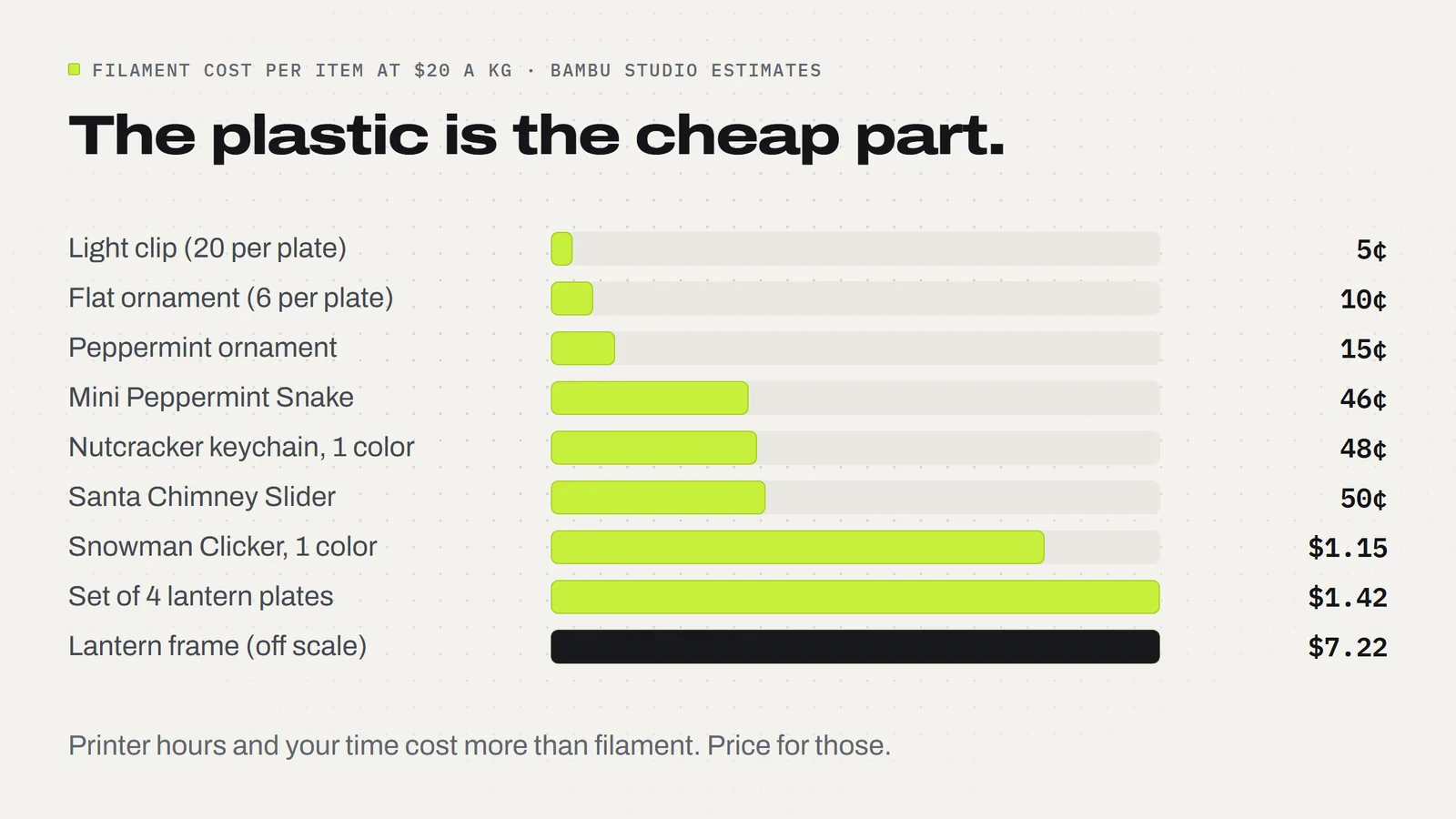
Here's the short list with real numbers. Times are Bambu Studio estimates for the supplied projects, including supports and color purge, so a real print lands close but not exact. Filament cost assumes a $20 spool of 1 kg; multiply the grams by your own spool price and divide by 1,000 if yours costs more or less.
| Per plate | Print time | Filament | Filament cost each | |
|---|---|---|---|---|
| Christmas Ornament Set (one color) | 6 ornaments | 2 h 22 min | 31 g | about 10 cents |
| Peppermint Candy Ornaments | 6 ornaments | 3 h 17 min | 45 g | about 15 cents |
| Peppermint Snake (mini) | 6 snakes | 15 h 41 min | 138 g | about 46 cents |
| Peppermint Snake (large) | 1 snake | 4 h 51 min | 55 g | about $1.11 |
| Chattering Nutcracker (one color) | 1 keychain | 1 h 40 min | 24 g | about 48 cents |
| Santa Chimney Slider (full color) | 1 keychain | 1 h 45 min | 25 g | about 50 cents |
| Snowman Clicker (one color) | 1 keychain, 2 plates | 3 h 09 min | 57 g | about $1.15 |
| Christmas Light Clips (gutter) | 20 clips | 2 h 58 min | 48 g (PETG) | about 5 cents |
| Lantern frame | 1 frame and roof | 18 h 10 min | 361 g | about $7.22 |
| Christmas decorative plates for the frame | a set of 4 | 3 h 50 min to 4 h 37 min | 70 to 71 g | about $1.42 a set |
The pattern is plain: filament is almost never the expensive part. A whole plate of ornaments costs less than a cup of coffee in plastic. What you're really spending is printer hours and your own time sorting, packing and pricing. That's why batch-friendly prints matter more than cheap ones.
Are 3D printed ornaments worth selling?
Yes, and they're the easiest place to start. Flat, layered ornaments (a solid backing with raised shapes on top) print lying down with no supports, so a beginner gets clean results. Our Christmas Ornament Set prints all six (a snowflake, a snowman, a candy cane, a gingerbread man, a tree and a blank name banner) on one plate in 2 hours 22 minutes with 31 g of filament. That's about 24 minutes and 5 g per ornament.
The Peppermint Candy Ornaments are six candy shapes in red, white and green, and print in 3 hours 17 minutes for all six. The Christmas Character Ornaments (a reindeer, a penguin, a cardinal, a nutcracker, a gnome and a polar bear) take 47 minutes to 1 hour 10 minutes each.
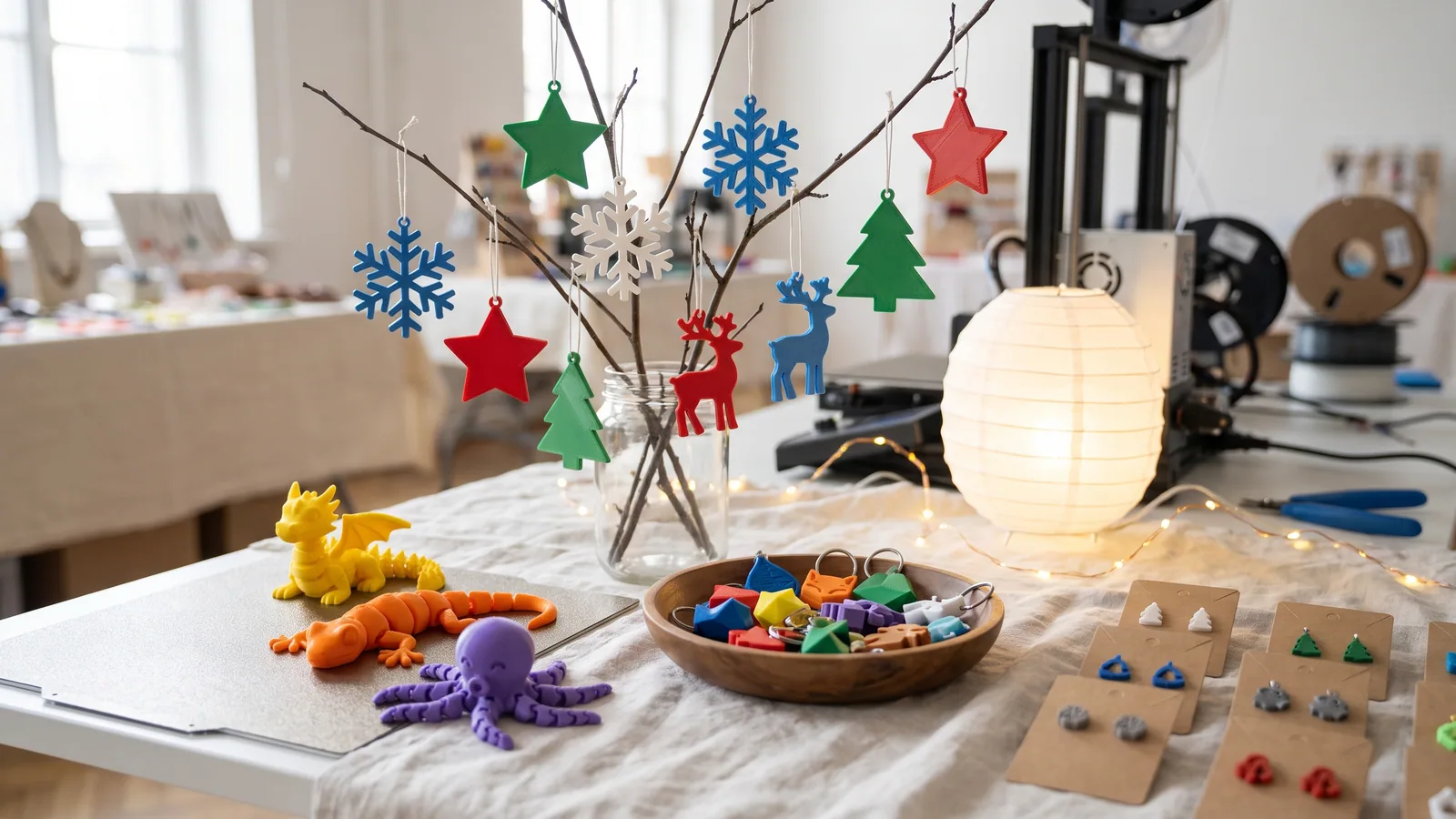
Two tips for the fair table. First, the blank name banner is your upsell: offer to write a name on it with a paint pen while the customer waits. Second, ornaments sell better hung than piled. A small tree branch in a jar, or a pegboard, shows them the way they'll look at home. Our ornament guide covers printing them in more detail.
Do flexi and fidget prints sell?
Flexi toys are the prints that stop people walking past. A flexi (or "print-in-place") toy comes off the printer already joined, with parts that move, so there's nothing to assemble. Our Peppermint Snake is a wiggly snake made of peppermint candies, and the six-pack layout is built for exactly this job.
Here's our number for it: six mini Peppermint Snakes print on one plate in 15 hours 41 minutes with 138 g of PLA. That works out to about 2 hours 37 minutes and 23 g each, roughly 46 cents of filament per snake. Each mini snake is about 245 mm (9.7 inches) long. Start the plate before bed and you wake up to six finished snakes.
Leave one on the front of the table for people to play with. Kids will find it, and their parents will follow. The snake prints in three colors, which needs an AMS (Bambu Lab's automatic filament changer) or a similar multi-color system; in one color it prints on any printer from the STL.
One warning that saves a lot of wasted plastic: never scale a print-in-place model up or down. The gaps between moving parts are measured for the size it was designed at. Shrink it and the joints fuse together. Our print-in-place guide covers the other causes of fused joints and how to free a stiff one.
Are 3D printed keychains good sellers?
Keychains are the classic impulse buy: small, cheap, and easy to give as a stocking stuffer. The ones worth printing do something when you fidget with them.
- Chattering Nutcracker: a nutcracker soldier whose chin swings open and clacks shut. 1 hour 40 minutes and 24 g in one color.
- Santa Chimney Slider: a little Santa slides down a brick chimney and clicks into three stops. 1 hour 45 minutes and 25 g in full color.
- Snowman Clicker: a snowman whose top hat is a button that clicks and springs back. 3 hours 9 minutes and 57 g in one color, across two plates.
Color makes a big difference to print time on keychains. Each color change means the printer stops, swaps filament and purges a little of the old color. The Chattering Nutcracker goes from 1 hour 40 minutes in one color to 10 hours 11 minutes in full color. The Snowman Clicker goes from about 3 hours to about 8 hours 38 minutes. For a fair, where you want a dozen of something, printing one-color keychains in three cheerful filaments is often the smarter plan than a few full-color ones. Keep a couple of full-color versions on the table as the eye-catchers.
The metal split rings aren't printed. Buy them in packs of 100 and fit them before the fair, not at the table.
Do 3D printed earrings sell at craft fairs?
Earrings are small, light and easy to display on a card, which makes them a natural fair item. Our Christmas Earrings are four pairs: gingerbread men, candy canes, snowflakes and Christmas trees. Every charm is 2.4 mm thick and about 26 to 30 mm tall, prints flat with no supports, and has a 2 mm hole for a jump ring.
The ear wires and jump rings aren't included, so budget for hardware: our guide to 3D printed earrings works a full pair out at about $1.65, with the colors, hooks and settings explained. Use nickel-free or hypoallergenic ear wires and say so on the card; it's the first question many earring buyers ask. Mount each pair on a small printed or paper card with your shop name, and hang the cards on a rack or pegboard so they're at eye level.
What should be the centerpiece of a 3D print craft fair table?
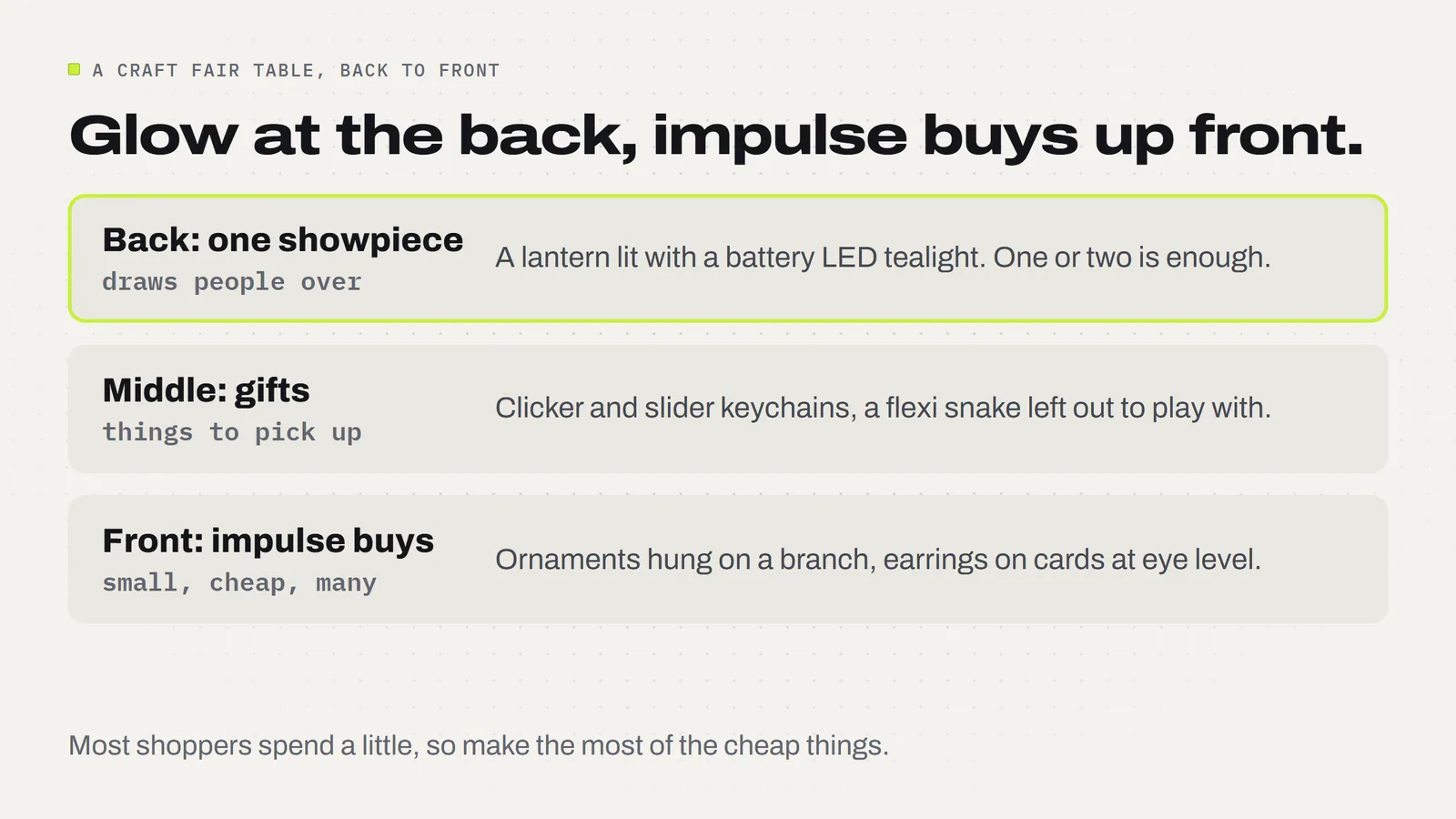
One thing that glows. A lit lantern on a dim December evening, or under the flat lights of a school gym, pulls people across the room. It doesn't have to be your best seller; its job is to bring people close enough to see everything else.
Our Modular Lantern Frame is a lantern frame you print once, plus decorative plates that slide into its four sides. The frame and roof take about 18 hours 10 minutes and 361 g of PLA. A set of four Christmas decorative plates, such as the North Pole Lantern Panels (Santa's workshop, his sleigh and reindeer, Santa at the chimney, and a pile of toys), takes 3 hours 55 minutes and 71 g.
That frame-plus-plates setup is useful at a fair. You can sell the lantern with one set of plates, then sell extra plate sets to the same customer for other seasons. Light it with a battery LED tealight only, never a real candle: PLA starts to soften at around 55 to 60 °C. Our Christmas lantern guide has the details, and our craft fair display ideas cover risers, lighting and signs for the rest of the table.
How much stock should you print for a craft fair?
There's no reliable formula, and anyone who gives you one is guessing about your fair. What you can plan is printer time. Work backwards from the date:
- Count your printer hours. If your printer can run about 10 hours a day on weekdays and more at weekends, three weeks gives you roughly 200 to 250 hours, minus failed prints and plate changes.
- Print the long jobs first. A lantern frame (18 hours) or a plate of six mini snakes (almost 16 hours) is best started early, when a failed print can be redone.
- Fill gaps with short plates. A 2 to 3 hour ornament plate fits an evening.
- Make more of the cheap things. Ornaments, earrings and keychains are where most fair sales happen, because most shoppers spend a little. A showpiece or two is enough.
- Keep a notebook after your first fair. Write down what sold, what got picked up and put back, and what people asked for. That is the real data for next year.
Remember the extras that aren't printed: split rings, ear wires, LED tealights, bags, price stickers and a card reader if you take cards.
How should you price 3D prints for a craft fair?
Start from cost, then check what the item is worth to the shopper. Your cost is filament (the table above), plus electricity, hardware, packaging, a share of failed prints, and your time. The shopper doesn't care about any of that; they compare your ornament with the one on the next table. Price clearly, round to whole dollars so change is easy, and consider a small discount for multiples, like three ornaments for a set price, because it nudges a one-item sale into three.
Most importantly, don't price by filament alone. An ornament with 10 cents of plastic still took 24 minutes of printer time and a few minutes of your time to check, bag and label.
For the full formula worked through on a real design, see how to price 3D prints you sell.
Can you sell prints made from 3MF Labs designs?
Yes. The 3MF Labs license lets you sell the physical prints you make from our designs, with no limit and no royalty. You can't share, upload, resell or give away the files themselves, or remixes of them. Our guide to selling 3D prints covers the rest.
Every design comes as a 3MF project for Bambu Studio and as STL files for any other slicer, so you can print on whatever printer you have. Browse the full list of designs to plan your table.
Designs from this guide
 $3.79
3ML-021 · Ornament set
Christmas Ornament Set
Six flat layered tree ornaments with bold black outlines: a snowflake, a snowman, a candy cane, a gingerbread man, a Christmas tree and a blank name banner you personalize. STL + 3MF · 8.7 MB View model $3.79
3ML-029 · Ornament set
Peppermint Candy Ornaments
Six flat layered peppermint tree ornaments with bold black outlines: a round swirl, a wrapped candy, a candy cane with holly, a star, a heart and a striped bell with a bow. STL + 3MF · 8.6 MB View model $3.79
3ML-013 · Flexi snake
Peppermint Snake
A wiggly snake made of peppermint candies, with black eyes and a red tongue. It prints in one piece, already joined, so there's nothing to put together. STL + 3MF · 23 MB View model $3.79
3ML-026 · Fidget keychain
Chattering Nutcracker
A nutcracker soldier keychain whose chin swings open and clacks shut: tall black hat with a red plume, curled white hair, a big black mustache and a little white beard. STL + 3MF · 12 MB View model $3.79
3ML-020 · Slider fidget
Santa Chimney Slider
A snowy brick chimney keychain with a little Santa who slides down the middle and clicks into three stops. STL + 3MF · 217 KB View model $3.79
3ML-036 · Fidget clicker
Snowman Clicker
A chubby Christmas snowman in a red knit scarf whose little top hat has a button that clicks and springs back, on a keyring loop. STL + 3MF · 5.9 MB View model $3.79
3ML-028 · Earring collection
Christmas Earrings
Four pairs of Christmas earrings: gingerbread men, candy canes, snowflakes and Christmas trees. STL + 3MF · 4.0 MB View model $2.49
3ML-012 · Lantern frame
Modular Lantern Frame
The Modular Lantern's frame, roof and carry handle. Print it once, then slide in a set of panels for every season. STL + 3MF · 2.0 MB View model $3.79
3ML-011 · Lantern panels
North Pole Lantern Panels
Four light-up North Pole scenes for our Modular Lantern: Santa's workshop, his sleigh and reindeer, Santa at the chimney, and a pile of toys. STL + 3MF · 9.0 MB View modelQuestions
What 3D prints sell best at craft fairs?
Prints that are cheap to make, print in batches, explain themselves at a glance and do something: flat Christmas ornaments, flexi toys like an articulated snake, clicker or slider keychains, earrings, and one lit lantern as a centerpiece. At a November or December fair, holiday designs give shoppers a reason to buy that day.
How much does it cost to 3D print an ornament?
Very little in filament. Our Christmas Ornament Set prints six ornaments in 2 h 22 min with 31 g of PLA, about 5 g each. At $20 for a 1 kg spool that is about 10 cents of filament per ornament. Printer time, hardware, packaging and your own time cost more.
How long does it take to print stock for a craft fair?
Plan in printer hours. An ornament plate takes 2 to 3 hours, a plate of six mini Peppermint Snakes 15 h 41 min and a lantern frame about 18 hours. Three weeks of steady printing gives roughly 200 to 250 hours, so start the long jobs first and fill evenings with short plates.
Do I need a multicolor printer to sell 3D prints at a fair?
No. Ornaments, keychains and snakes all print in one color from the supplied files, and printing one-color items in a few bright filaments is much faster. Full color on a small keychain can take six times longer: our Chattering Nutcracker goes from 1 h 40 min to 10 h 11 min.
Should I print full-color or one-color keychains to sell?
Mostly one color, plus a few full-color ones as eye-catchers. Every color change stops the printer to swap and purge filament. Our Snowman Clicker takes about 3 h 9 min in one color and 8 h 38 min in full color, so one color lets you make far more stock.
What can I put on a 3D print craft fair table to attract people?
Something that glows and something people can touch. A lantern lit with a battery LED tealight draws people across the room, and a flexi snake left out to play with keeps them at the table. Use LED lights only, never candles: PLA softens at around 55 to 60 °C.
Can I sell prints made from 3MF Labs designs at a craft fair?
Yes. The 3MF Labs license lets you sell the physical prints you make from our designs, with no limit and no royalty. You cannot share, upload, resell or give away the files themselves or remixes of them.
What extras do I need besides the prints?
Hardware and packaging that isn't printed: metal split rings for keychains, ear wires and jump rings for earrings, battery LED tealights for lanterns, small bags, price labels, display hooks or a pegboard, and a card reader if you take cards.
Sources
Filed under Selling your prints