3D Printed Stocking Holders: Weight, Hooks and Mantel Tips
A printed stocking holder is plastic, and plastic is light. Here is how a printed holder gets the weight to hold a full stocking, how to print a hook that won't snap, and where to set it on the mantel.
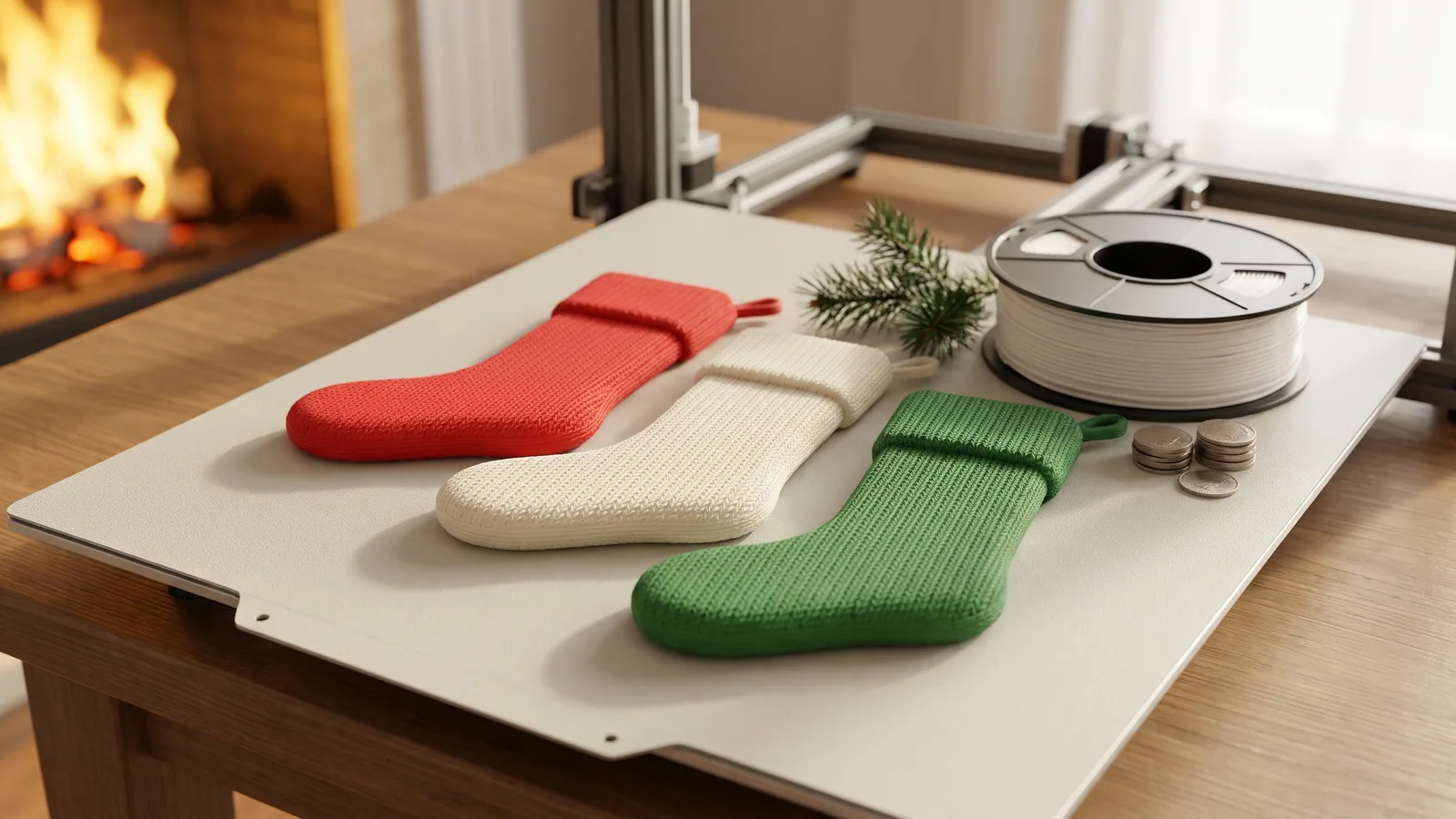
A stocking holder has one job: sit on the mantel and keep a full stocking from crashing to the floor. Store-bought ones do it with a heavy cast-metal base. A 3D printed one is plastic, and plastic is light, so a printed holder has to get its weight from somewhere else.
This guide covers what makes a printed stocking holder safe to hang, how much weight it needs, how the hook should be printed, and how to set it on your mantel. The numbers come from our own Christmas Stocking Holders, a set of four we designed and tested the fit of, so you can see the real figures rather than guesses.
Can you 3D print a stocking holder?
Yes, and it is one of the more satisfying Christmas prints because people use it every year. The catch is that a printed holder is not a metal holder made of plastic. A cast-iron holder is heavy all the way through, so it stays put. A PLA one of the same size is far lighter, because most printed parts are partly hollow inside, and a stocking hanging off the front edge can tip it forward.
So a good printed design does three things a metal one doesn't need to think about:
- It adds weight at the back. Coins, washers or another dense filler go into the base, as far from the hanging stocking as possible.
- It prints the hook the strong way. The hook carries the whole load, so its layers have to run along the curve, not across it.
- It tells you where to put it. How far the base sticks out over the mantel edge matters as much as how heavy it is.
If you are new to printing from a ready-made project file, our Bambu Studio beginner's guide covers opening one and pressing print.
Are 3D printed stocking holders heavy enough?
Not on their own. That is the honest answer, and it is why "weighted stocking holders" is the phrase people search for. A printed holder becomes heavy enough once you add ballast, which is just extra weight hidden where it does the most good.
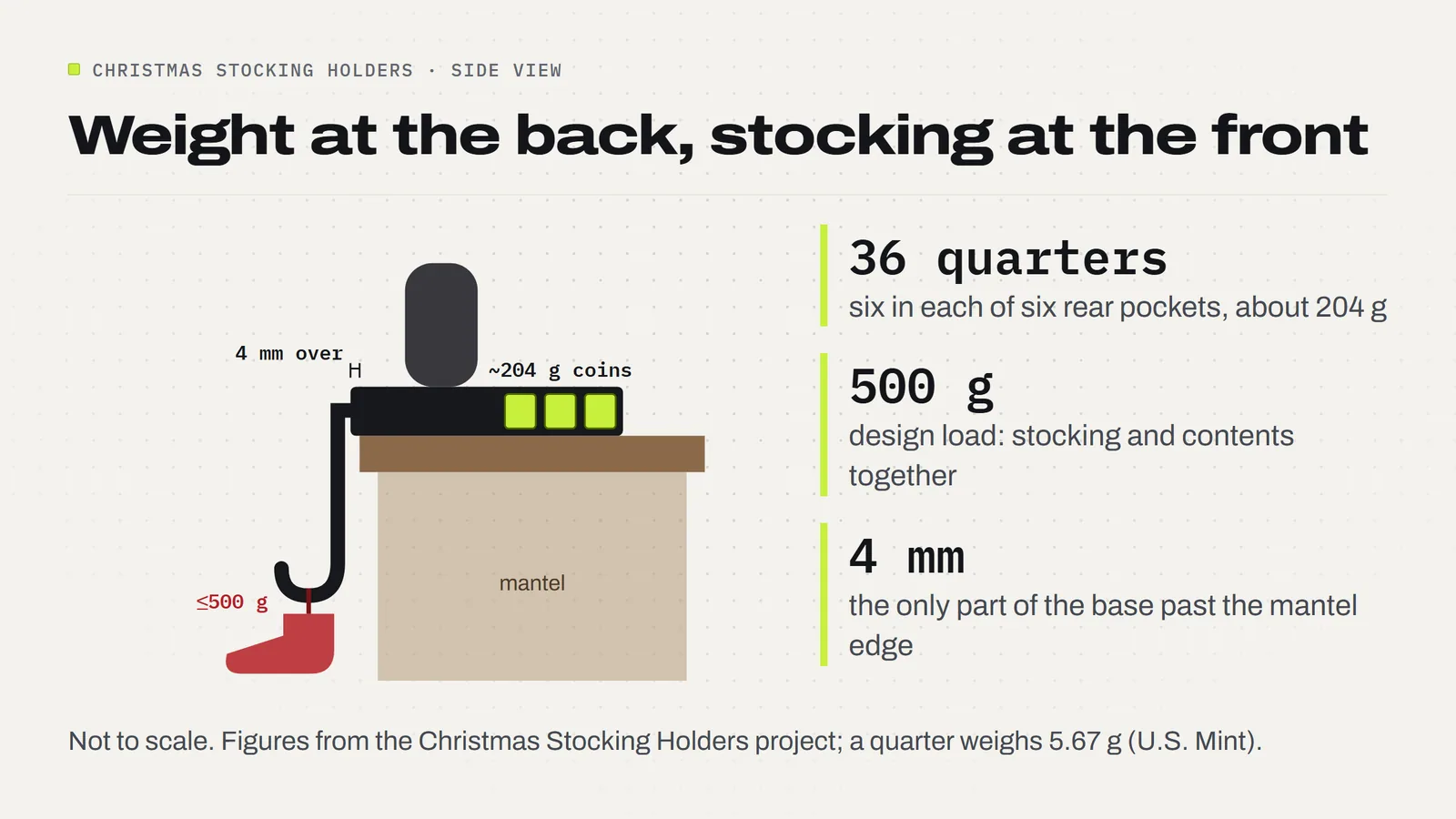
Here is the real example. Each of our holders has six round pockets under the back of the base. The design calls for 36 US quarters per holder, six in each pocket. A quarter weighs 5.67 grams, so that is about 204 grams of coins per holder. With that ballast, the 40% infill the project is saved with, and the base placed as described below, each holder is designed for a stocking of up to 500 grams, contents included.
Two things matter about that number:
- Where the weight sits. The coins go in the rear pockets, not spread across the base. Weight at the back is what stops the holder rocking forward.
- Even stacks. Six quarters in every pocket, not twelve in two pockets and none in the rest. Uneven stacks can make the base lean to one side.
No quarters to spare? Flat steel washers work too: five per pocket, 30 in all, about 222 grams in total. Weigh your washers, because sizes vary and a washer with a bigger hole is lighter. Don't use aluminium washers; they look the same and weigh about a third as much.
How much weight can a stocking holder hold?
It depends entirely on the design, the ballast and where you put it, so go by the number the designer gives you. Ours is 500 grams per holder, and that includes the stocking itself. A thick knitted or felt stocking has real weight before anything goes in it, so weigh yours on a kitchen scale if you are near the limit.
It is a design load, not a certified rating. Start light, add the contents slowly while steadying the base, and check that nothing rocks, slides or creaks before you let go. If the base moves, take the stocking off and rethink where it sits.
Here is how the four holders in our set compare:
| Holder | Height (figure + base) | Colors in the figure | Needs an AMS for full color? |
|---|---|---|---|
| Nutcracker soldier | 147 mm | 6 | Yes |
| Snowman | 146 mm | 5 | Yes |
| Christmas tree | 153 mm | 3 | Yes |
| Gingerbread house | about 131 mm | 3 | Yes |
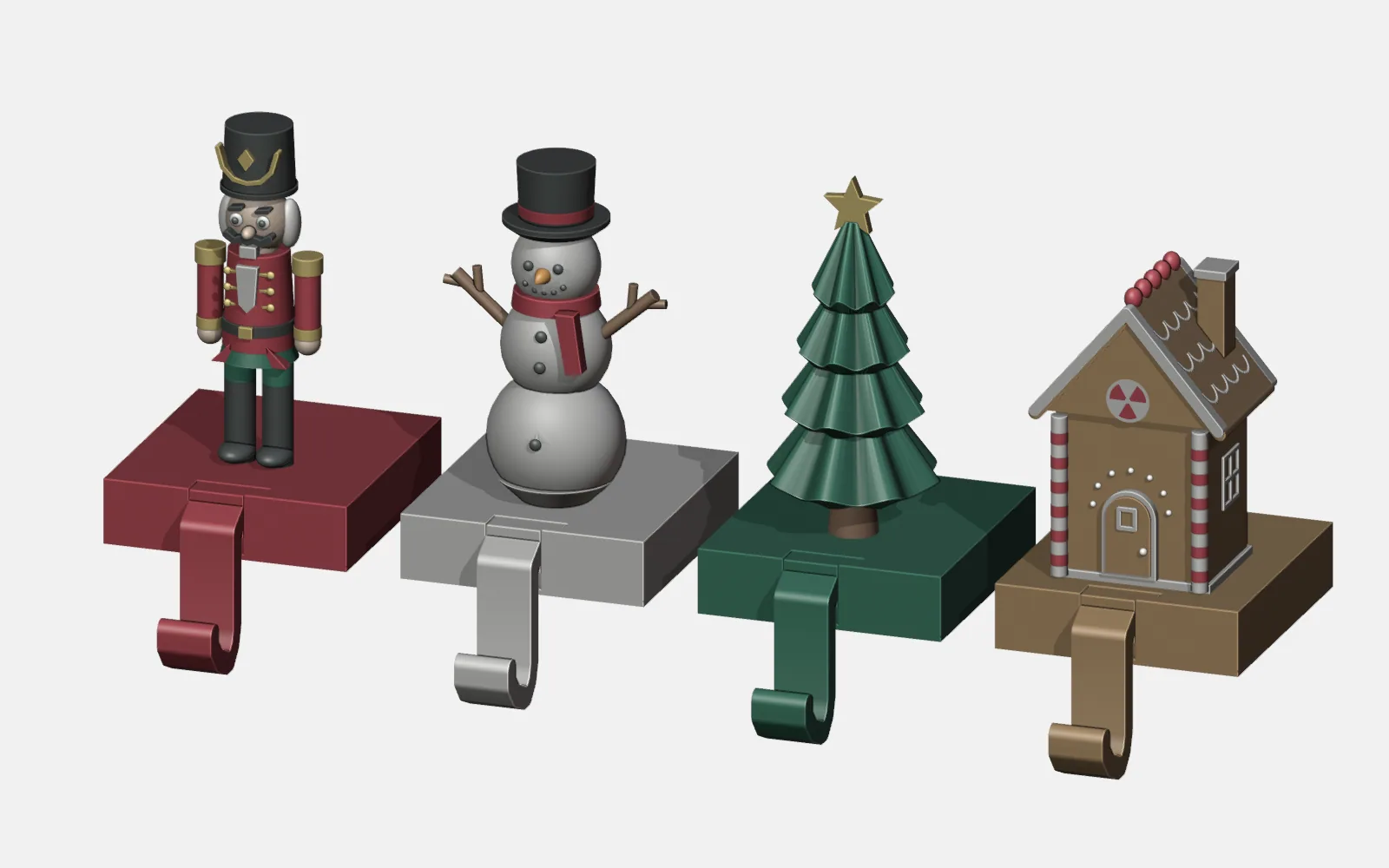
All four share the same 90 × 100 mm base, the same hook and the same lid, and all four hold the same 500 grams. The heights add 2 mm once the lid is on. Every part also prints in a single color if you don't have an AMS (Bambu's automatic filament changer); you just lose the painted-on details. Our guide to whether you need an AMS explains the difference.
How do you print a stocking hook so it doesn't snap?
Print it lying on its side. This is the one setting that matters most, and it comes down to how a printer builds things.
A print is a stack of thin layers. Each layer is strong along its length but weaker where it is bonded to the layer below. If you print a J-shaped hook standing upright, the layers run straight across the bend, and the weight of a stocking pulls them apart right at the curve. Printed on its side, the layers follow the shape of the J, so the load runs along them instead.
Our hooks are saved in the project already on their side, at 100% infill (solid plastic, no hollow inside), so you don't have to change anything. If you print from the STL file in another slicer, keep the hook the way it arrives and set infill to 100% yourself. The figure and base print at 40% infill, and that number is part of the weight calculation, so don't lower it to save filament.
The hook slides down into a keyed slot at the front of the base until it stops. No screws and no glue. It comes back out with a gentle pull upward, which makes the holders easy to pack away in January.
How do you make stocking holders heavier?
If you already have a holder that tips, printed or not, the fixes are the same:
- Add weight at the back. Coins or steel washers under the rear of the base work best. On a design without pockets, a small bag of coins tucked behind the base adds weight, but it looks untidy and can slide off.
- Raise the infill on a reprint. More infill makes the plastic itself heavier. It helps, but it is slow and won't match what a stack of coins adds.
- Pull the base back. The further the base hangs over the mantel edge, the more leverage the stocking has. Less overhang is safer.
- Lighten the stocking. Heavy gifts go under the tree. Sweets and small things go in the stocking.
What doesn't work: double-sided tape, sticky tack or glue on the mantel. They can hold until the stocking gets heavy, then let go all at once, and they can damage the mantel finish.
Where do you put stocking holders on a mantel?
On a flat, level shelf that supports the whole base. For our design, the front edge of the base sits just 4 mm past the edge of the mantel. That small overhang lets the hook drop straight down in front of the mantel face with room to spare, while nearly all of the base stays on the shelf.
A few things to check before you hang anything:
- Is the edge flat? A rounded lip or a projecting moulding can stop the base sitting flat. If it rocks, it is the wrong spot.
- Is the mantel deep enough? Our base needs about 96 mm of shelf behind the front edge.
- Is the loop at the bottom of the hook? Hang the stocking's loop in the bottom of the J, never on the outer tip.
- Is the surround cold? PLA, the most common printing plastic, starts to soften at around 55 to 60 °C. Don't use printed holders on a hot fireplace surround or above an open fire, and keep them out of direct sun through a window.
- Who can reach it? Keep holders out of reach of small children and pets, and keep loose coins and small printed parts away from little hands. No tugging on a filled stocking.
How long does it take to print a set of stocking holders?
Longer than an ornament, shorter than a lantern. Each holder is three separate prints: the figure and base in one piece, the hook, and the lid. A set of four is twelve prints. The full-color figures are the slow part, because an AMS swaps filament inside each layer and the nutcracker alone uses six colors.
We don't publish a print time for this set: the projects are saved ready to slice for your own printer, and the time depends on your printer, filament and how many colors you load. Slice the nutcracker first, see what Bambu Studio estimates, and plan the rest from there. With Christmas a few weeks out, start the figures now and leave the hooks and lids, which are quick, for last.
The figures need a few small tree supports under overhangs like the snowman's arms and the tree's branches. The bases, hooks and lids need none. Our guide on adding supports in Bambu Studio explains how to remove them cleanly.
Can you sell 3D printed stocking holders?
If you buy our design, yes. Our license lets you sell the physical holders you print, with no quantity limit and no royalty. You can't share or resell the files themselves.
Stocking holders are a good fit for a holiday market table because they are a gift for the whole household, and a set of matching holders is an easy sell to a family with more than one stocking. If you are pricing them, our guide on how to price 3D prints walks through filament, power and time, and the craft fair display guide has ideas for showing them off. One practical tip: if you sell them, include the coin and placement instructions with each one, since the buyer has to add the ballast at home.
More Christmas prints to go with them
Stocking holders pair well with other mantel pieces. Our Christmas 3D prints guide covers the season's best prints to make and sell, and the Christmas lanterns guide covers the lantern frame + decorative plates, which glow on a mantel next to the holders. For gift ideas, see 3D printing gift ideas. You can browse every design in the shop; each one downloads as a ready-to-print 3MF project plus STL files.
Designs from this guide
 $5.99
3ML-016 · Mantel decor
Christmas Stocking Holders
Four weighted stocking holders for the mantel: a nutcracker soldier, a snowman, a Christmas tree and a gingerbread house. STL + 3MF · 9.2 MB View model $2.49
3ML-012 · Lantern frame
Modular Lantern Frame
The Modular Lantern's frame, roof and carry handle. Print it once, then slide in a set of panels for every season. STL + 3MF · 2.0 MB View model $3.79
3ML-011 · Lantern panels
North Pole Lantern Panels
Four light-up North Pole scenes for our Modular Lantern: Santa's workshop, his sleigh and reindeer, Santa at the chimney, and a pile of toys. STL + 3MF · 9.0 MB View model $3.79
3ML-013 · Flexi snake
Peppermint Snake
A wiggly snake made of peppermint candies, with black eyes and a red tongue. It prints in one piece, already joined, so there's nothing to put together. STL + 3MF · 23 MB View modelQuestions
Are 3D printed stocking holders heavy enough?
Not on their own. Plastic is light, so a printed holder needs ballast in the base. Ours takes 36 US quarters (about 204 g) in six rear pockets, which lets it hold a stocking of up to 500 g including the stocking.
What can I use to weigh down a stocking holder?
US quarters or flat steel washers in the back of the base work best. Our design takes six quarters per pocket, or five steel washers per pocket (about 222 g in all). Don't use aluminium washers; they are far lighter.
How much weight can a 3D printed stocking holder hold?
It depends on the design and ballast. Ours is designed for 500 g per holder, stocking and contents together, with the coins in place and the base set correctly. It is a design load, not a certified rating, so start light.
How should I print the hook?
On its side, at 100% infill, so the layers follow the curve of the J. A hook printed upright has its layers running across the bend, which is where it would break.
How far should a stocking holder hang over the mantel?
As little as possible. Our base sits with its front edge only 4 mm past the mantel edge, on a flat, level shelf at least 96 mm deep. A rounded or sloping lip is the wrong spot.
Can I use a 3D printed stocking holder over a fireplace?
Only on a cold mantel. PLA starts to soften around 55 to 60 °C, so never use printed holders on a hot surround or above an open fire.
Do I need an AMS to print stocking holders?
For the full-color figures, yes: our nutcracker uses six colors and the snowman five. Every part also prints in one color without an AMS. The base, hook and lid are always one color.
Can I sell the stocking holders I print?
Yes, with our design. The 3MF Labs license lets you sell the physical holders you make, with no limit and no royalty. You can't share or resell the files.
Filed under Seasonal prints