Thanksgiving 3D Prints for 2026: Harvest Lantern Plates, Earrings and a Cornucopia Candy Bowl
Six weeks to Thanksgiving: four fall designs, what each takes to print, and the honest notes on candy, lights and colors.
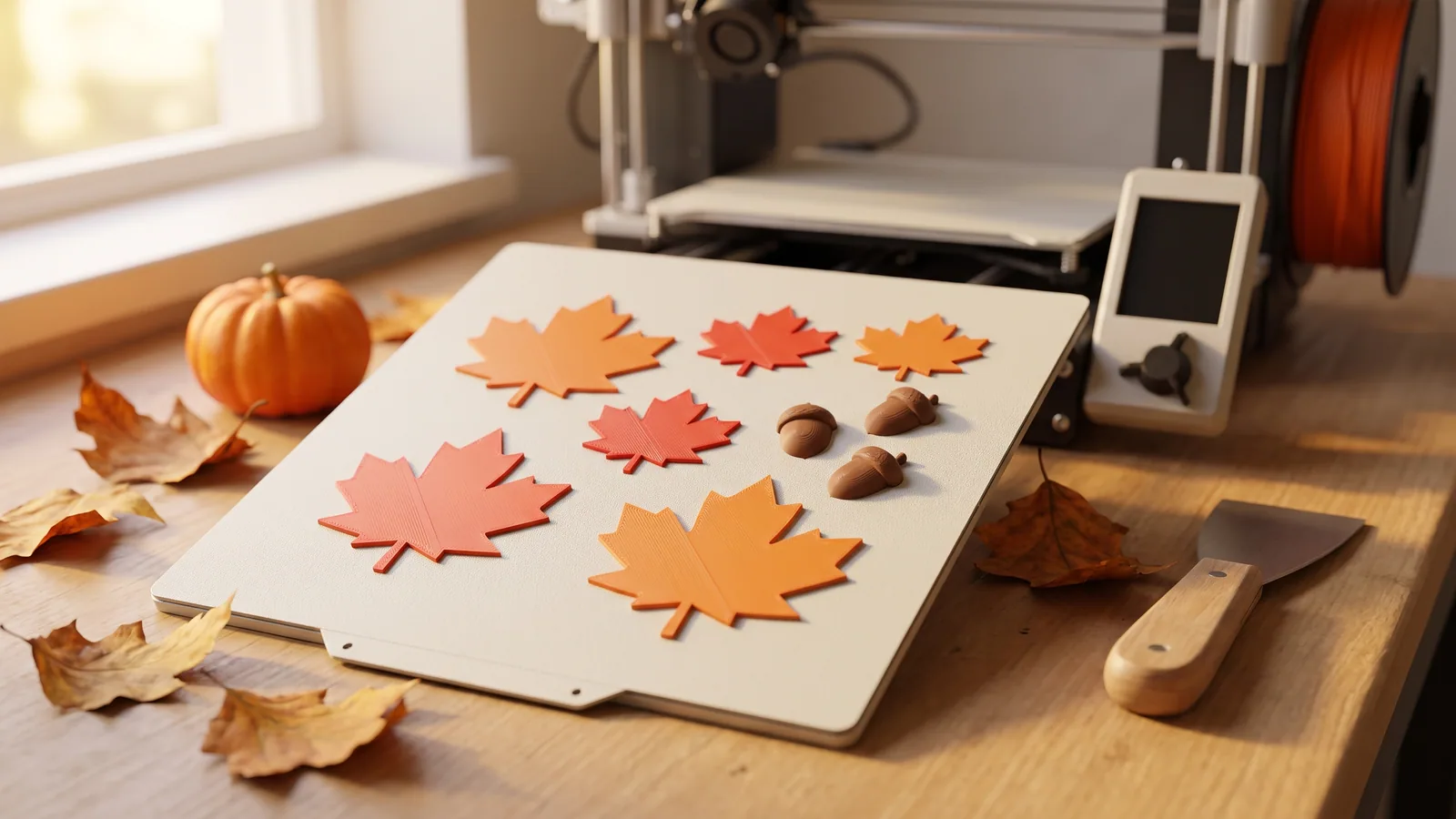
Thanksgiving falls on Thursday 26 November this year, which leaves about six weeks to print anything you want on the table, on a mantel or on a craft fair stand. That's plenty of time if you start now and pick prints that don't fight you. Here are four Thanksgiving designs we made this fall, what each one takes to print, and the honest notes on candy, lights and colors.
All four are live on our designs page and each downloads as a print-ready 3MF project plus STL files. If you've never opened a 3MF before, our plain-English guide to 3MF files covers it in five minutes.
What can you 3D print for Thanksgiving?
Most Thanksgiving prints fall into three groups: things that sit on the table, things that glow, and small things people wear or give away. A good Thanksgiving print is quick to make, looks right from across a room, and doesn't need perfect color matching to read as "fall".
Our four, one from each group and one that lights up:
- The Harvest Lantern Panels: four decorative plates that slide into our lantern frame and glow when a battery LED light is inside. A pumpkin patch under a harvest moon, a turkey on a fence rail, falling maple leaves, and an oak branch with acorns.
- The Modular Lantern Frame: the frame, roof and carry handle the plates slide into. Print it once and change the plates with the season.
- The Thanksgiving Earrings: four pairs of flat layered charms, a turkey, a slice of pumpkin pie, a maple leaf and an acorn.
- The Cornucopia Candy Bowl: a woven-look horn with a rope rim and a curled tail, plus a cluster of pumpkins, an apple and wheat that hooks over the rim.
Between them they cover the table centerpiece, the glowing window or mantel piece, and the small, cheap item that sells fast at a fair.
How do the four Thanksgiving prints compare?
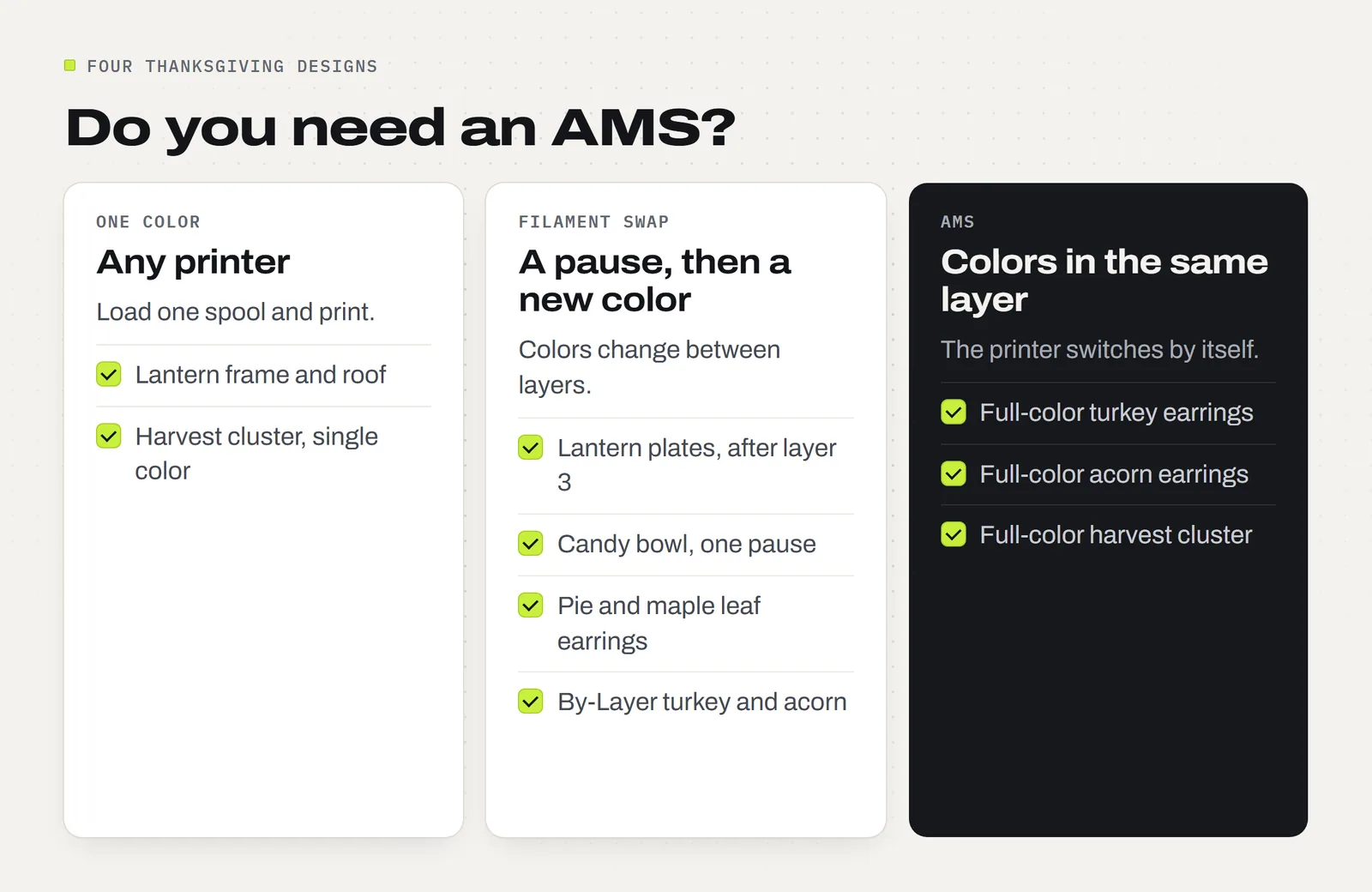
Here is the short version, with sizes and colors read from each design's own files. "AMS" is Bambu Lab's automatic filament changer, which lets a printer switch colors by itself in the middle of a layer.
| Design | What you print | Size | Colors | Need an AMS? | Price |
|---|---|---|---|---|---|
| Harvest Lantern Panels | 4 glowing plates | 90 × 120 mm each | 2 (a light backing, black artwork) | No: one filament change after layer 3 | $3.79 |
| Modular Lantern Frame | Frame + roof with handle | About 136 × 141 × 296 mm | 1, any color | No | $2.49 |
| Thanksgiving Earrings | 8 charms (4 pairs) | About 25 to 34 mm tall, 2.4 mm thick | Up to 7 | Only for the full-color turkey and acorn; the pie and leaf use filament swaps | $3.79 |
| Cornucopia Candy Bowl | Bowl + hook-on harvest cluster | About 22 × 16 × 16 cm | 2 for the bowl, 4 for the cluster | Only for the full-color cluster; the bowl uses one pause | $3.79 |
Every one of them prints without an AMS in some form. The table tells you where a color swap does the job and where the full-color version needs the changer.
How do you make a 3D printed Thanksgiving lantern?
Our lantern is two prints plus the plates. The frame and the roof print once each. The roof's round carry handle prints already attached, so there's no axle or clip to fit. Then you print the four harvest plates, slide one down each groove of the frame with the artwork facing out, set a battery LED light inside and lock the roof on with its press-and-slide latch. No screws, clips or glue.
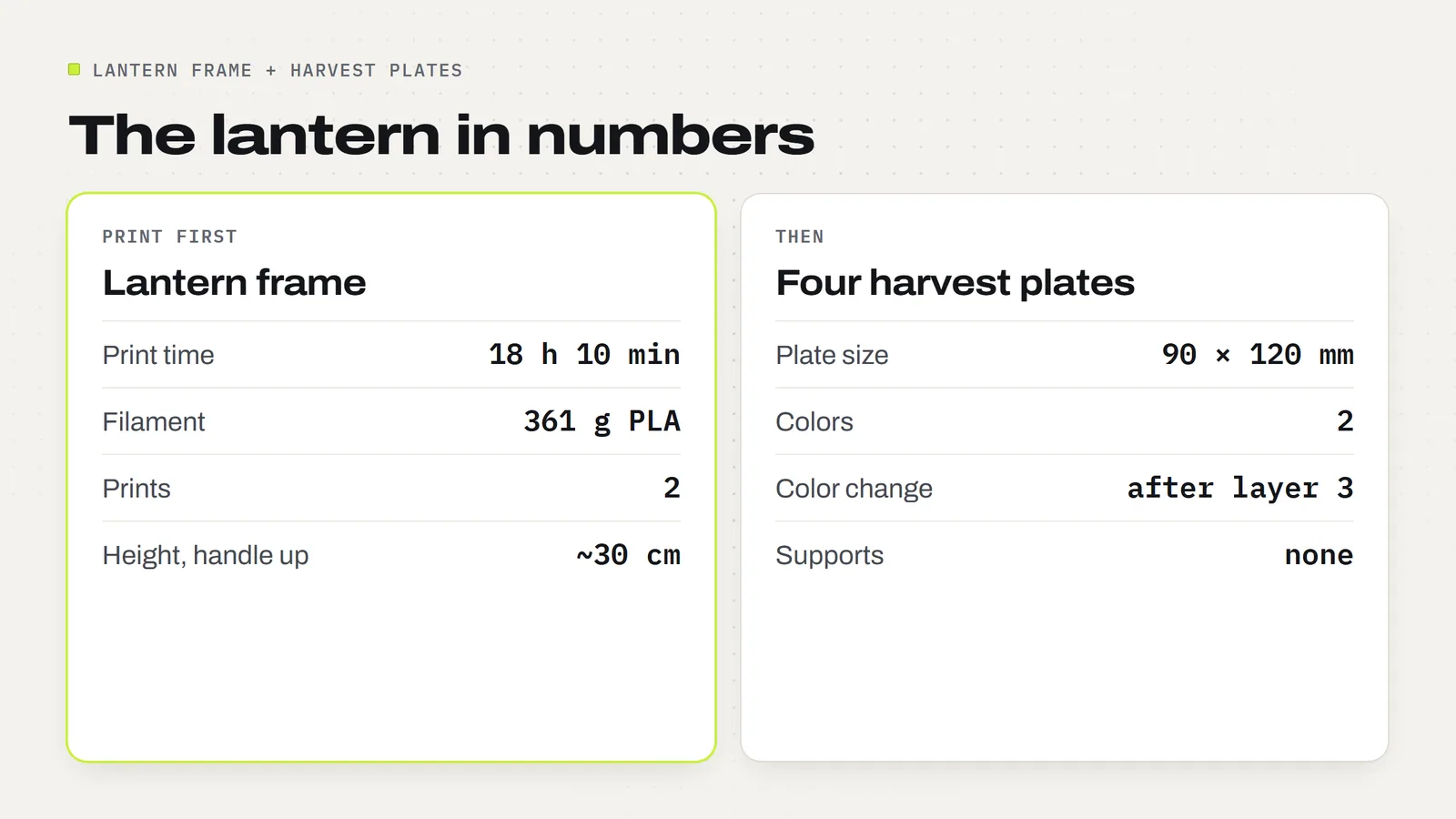
Here's the number we promised: the frame and roof together take 18 hours 10 minutes and 361 g of PLA on a Bambu Lab P2S, as estimated by Bambu Studio from the saved 3MF project. That's the long print, so start it first and let it run overnight. Finished, the lantern stands about 30 cm tall with the handle up, and the same frame takes our Christmas lantern plates next month.
The plates are the quick part. Each is a flat 90 × 120 mm panel: a thin light-colored backing that glows, with raised black artwork on top. The color change happens after the third layer, at 0.60 mm, so a printer with an AMS switches by itself and any other printer needs one filament change that you add in your slicer. You can print all four on one plate in one backing color, or one at a time to give each scene its own glow: warm yellow for the pumpkin patch, pumpkin orange for the turkey, red-orange for the leaves and golden olive for the acorns.
Two tips from the print notes:
- Keep the scale at 100%. The plates slide into grooves, and the roof lock and handle hinge are sized to the millimeter. Shrink anything and it won't fit.
- Leave the plate edges alone. Clean off strings, but don't sand or trim the edges, or the plates go loose in the grooves.
And one rule that isn't a tip: battery LED lights only. No candles, no flames, no hot bulbs. PLA, the plastic most of us print with, starts to soften at roughly 60 °C, its glass transition temperature, and parts can sag under load a little below that. A real candle flame is far hotter. A battery tea light or a string of fairy lights stays cool, and it is what the frame is designed for.
Can you 3D print a turkey?
Yes, and you don't need a big model to do it. "3D printed turkey" is one of the most searched Thanksgiving print ideas in November, and two of our designs have one.
The turkey plate in the Harvest Lantern Panels shows a strutting turkey with its tail fanned out on a wooden fence rail. Printed with a pumpkin orange backing, it glows orange behind the black artwork. It's flat, so it prints in well under the time of a standing figure and needs no supports.
The turkey earrings are a round little turkey with a red, orange and yellow tail fan and a brown body. The full-color version has several colors in the same layers, so it needs an AMS. Without one, print the "By-Layer" turkey that comes in the same download: its colors change only between layers, so you pause and swap filament instead.
Are 3D printed earrings a good Thanksgiving print?
They're about the best small print there is for the season. Each charm is 2.4 mm thick and 25 to 34 mm tall, prints flat with no supports and no brim, and all four pairs fit on one plate. They're light, cheap in filament, and easy to wear to dinner the same week you print them.
How the colors work, pair by pair:
- Pumpkin pie: caramel crust, orange filling, a white swirl of cream. Colors change only between layers, so pauses and swaps are all it needs.
- Maple leaf: red with raised orange veins. Also a layer-change print.
- Turkey and acorn: full color needs an AMS; each also comes in a By-Layer version for filament swaps.
Each charm has a sturdy round loop with a 2 mm hole. You'll need jump rings and ear wires, which aren't included; hinged click jump rings about 6 mm across close without tools. Keep the scale at 100% so the hole still fits the hardware, and check every pair before you wear or sell it. As with any small part, keep them away from young children.
Is a 3D printed cornucopia candy bowl safe for candy?
For wrapped candy, yes. For anything unwrapped, no. That's the honest line, and it's the one we put in the design's own notes. Our guide Is PLA food safe? explains why.
The reason isn't that PLA is poisonous. It's the layer lines. Every 3D print is built from thin layers, and the tiny grooves between them hold crumbs and are very hard to clean. Prusa's knowledge base makes the same point and adds that colored filaments can contain pigments and additives you can't vouch for. So fill the bowl with foil-wrapped chocolates, caramels in wrappers, or anything in its own packet, and keep loose food on a real plate.
As for the print itself, the bowl is a friendly one:
- It prints mouth-down, so the inside needs no supports. A few small tree supports go outside, under the tail and the foot.
- The brown rope rim comes from a single pause at 9 mm: start in coffee brown, swap to caramel and resume. The pause is already saved in the 3MF project.
- The harvest cluster (two pumpkins, an apple, four wheat ears and two leaves) needs an AMS with four colors for full color. Without one, print it in a single color; a one-color cluster in caramel or orange still reads as a cornucopia.
The mouth is about 14 cm across, which holds a good handful of wrapped candy. Wipe it with a damp cloth, keep it out of the dishwasher, and keep it out of hot sun for the same softening reason as the lantern.
Can you sell the Thanksgiving prints you make?
Yes. Every 3MF Labs design comes with a license that lets you sell the physical prints you make, with no limit on how many and no royalty. What you can't do is share, upload, resell or give away the files themselves. The full license is one short page, and our guide to selling 3D prints covers the practical side.
If you're printing for a fall fair, the earrings are the quick, low-cost item, and the lit lantern is the piece that makes people stop at the table. One lantern frame works with every set of our decorative plates, so the same frame can carry harvest plates now and Christmas plates in December.
When should you start printing for Thanksgiving?
Start with the longest print and work back from the date. A simple plan for a lantern, a bowl and a few pairs of earrings:
- This week: print the lantern frame and roof. At just over 18 hours, it's the one job that needs a free night.
- Next week: print the four harvest plates and the cornucopia bowl. Test-fit the plates in the frame before you make more sets.
- Two to three weeks out: print the earrings in batches, all four pairs on one plate, and assemble the hardware in front of the TV.
- Thanksgiving week: nothing left to print. Buy the wrapped candy and the LED tea light.
If you sell at fairs, move every step two weeks earlier, so your stock is ready before the first fair on your calendar rather than before the holiday itself.
The same lantern frame takes Christmas plates once the turkey is gone. Our guide to Christmas 3D prints for 2026 has the holiday designs with their print times, so the long jobs can start while the Thanksgiving ones are still on the plate.
Ready to pick? All four designs are on the designs page, each with photos of every scene and the full print settings. And if a download arrives as a file type you don't recognise, start with what a 3MF file is, or compare the formats in STL vs 3MF. Questions about downloads and accounts are answered in the FAQ.
Designs from this guide
 $3.79
3ML-014 · Lantern panels
Harvest Lantern Panels
Four light-up Thanksgiving scenes for our Modular Lantern: a pumpkin patch under the harvest moon, a turkey, falling leaves and acorns. STL + 3MF · 3.7 MB View model $2.49
3ML-012 · Lantern frame
Modular Lantern Frame
The Modular Lantern's frame, roof and carry handle. Print it once, then slide in a set of panels for every season. STL + 3MF · 2.0 MB View model $3.79
3ML-015 · Earring collection
Thanksgiving Earrings
Four pairs of Thanksgiving earrings: turkeys, pumpkin pie slices, maple leaves and acorns. STL + 3MF · 5.0 MB View model $3.79
3ML-017 · Candy bowl
Cornucopia Candy Bowl
A woven-look cornucopia horn that holds wrapped candy, with a curled tail and a harvest cluster that hooks over the rim. STL + 3MF · 12 MB View modelQuestions
What are good things to 3D print for Thanksgiving?
Table and mantel decor, light-up pieces and small wearables. A cornucopia candy bowl for the table, a lantern with glowing harvest plates for a window or mantel, and turkey, pumpkin pie, maple leaf or acorn earrings are all quick to print and easy to give or sell.
Can you 3D print a turkey for Thanksgiving?
Yes. A flat turkey prints fastest: our Harvest Lantern Panels include a turkey plate that glows in the lantern, and the Thanksgiving Earrings include a turkey pair. The full-color turkey earrings need an AMS; a By-Layer version prints with filament swaps instead.
Do I need an AMS to print Thanksgiving decorations?
No. The lantern plates need one filament change after layer 3, the candy bowl one pause at 9 mm, and the pie and maple leaf earrings change color only between layers. Only the full-color turkey and acorn earrings and the full-color harvest cluster need an AMS, and each can also print another way.
Can I put a candle in a 3D printed lantern?
No. Use battery LED lights only. PLA starts to soften at roughly 60 °C, and a candle flame is far hotter. A battery tea light or LED fairy lights stay cool and give the plates their glow.
Is a 3D printed candy bowl food safe?
Use it for wrapped candy only. The grooves between printed layers are hard to clean, and colored filaments can contain pigments and additives you can't vouch for. Keep loose, unwrapped food on a real plate, and wipe the bowl with a damp cloth rather than washing it in a dishwasher.
How long does it take to print a Thanksgiving lantern?
Our Modular Lantern Frame, the frame and the roof with its handle, takes about 18 hours 10 minutes and 361 g of PLA on a Bambu Lab P2S, according to Bambu Studio's estimate for the saved project. The four flat harvest plates are much quicker, so print the frame first.
Can I sell the Thanksgiving decorations I print?
Yes, with our designs. The 3MF Labs license lets you sell the physical prints you make, with no limit and no royalty. You can't share, upload, resell or give away the files themselves.
When should I start printing for Thanksgiving?
About six weeks out. Print the longest job first, such as a lantern frame, then the plates and bowl, then small items like earrings in batches. If you sell at fairs, start two weeks earlier so your stock is ready before the first fair.
Sources
Filed under Seasonal prints