Is PLA Food Safe? What It Means for Candy Bowls and Cookie Cutters
The plastic is used in food packaging. A printed part is a different object. Here is what that means for the candy bowls and cookie cutters you print this season.
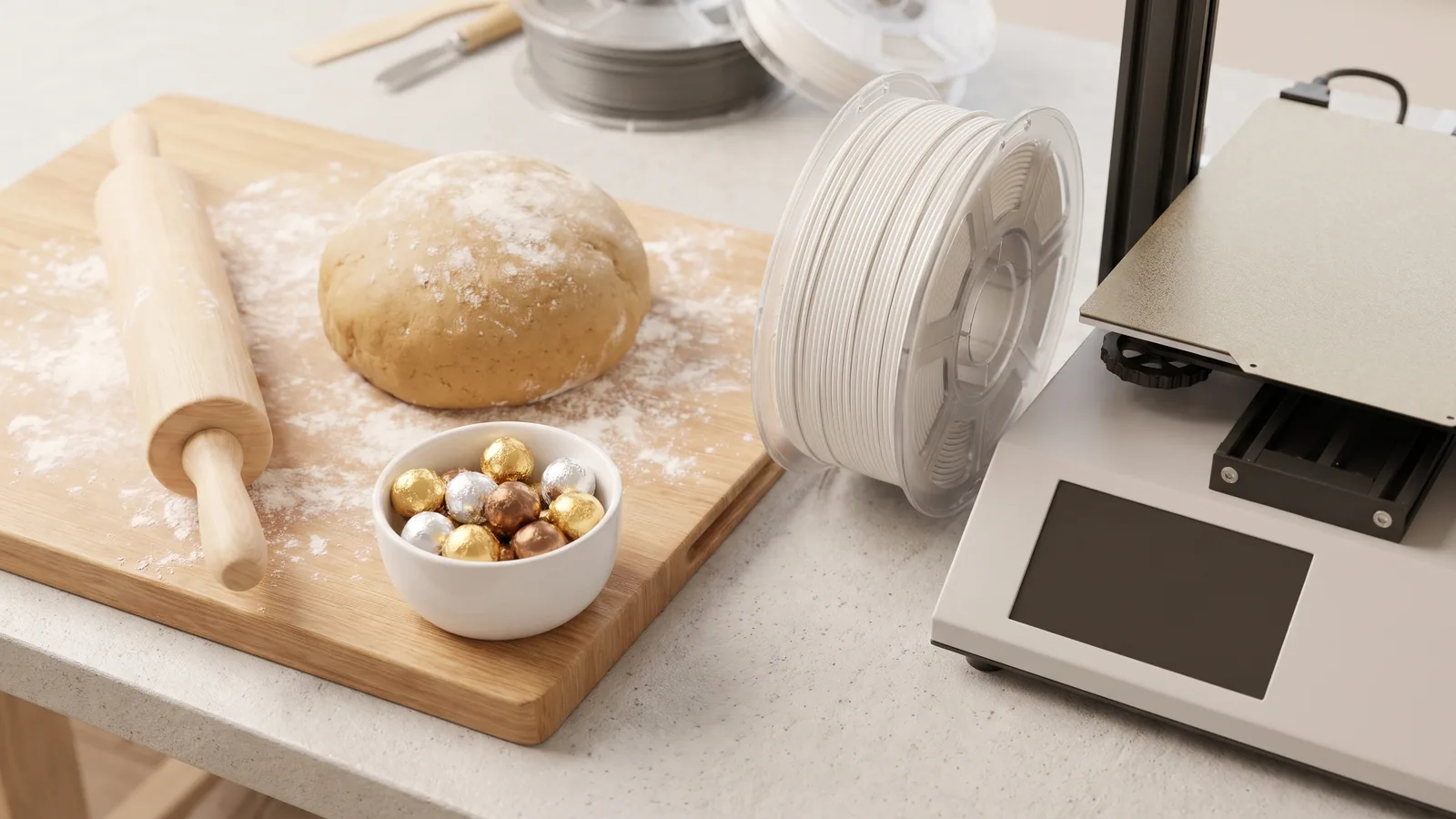
Candy bowls and cookie cutters are two of the most popular things people print in November and December, and the question that comes with them is always the same: is PLA food safe? The honest answer has two halves. The plastic itself is used in food packaging. A 3D printed part made from it is a different object, with grooves, pigments and a low softening point, and that changes what you should put in it.
This guide explains the difference in plain English, gives a simple rule for which prints can touch food, and shows what we do with our own designs: the candy bowls are for wrapped candy, and the cookie cutters are a short-contact tool you wash by hand and replace now and then.
Is PLA food safe?
PLA (polylactic acid) is a plant-based plastic, and the plain resin is used for food packaging such as cups and containers. The U.S. Food and Drug Administration keeps a public inventory of food contact substances, and several PLA resins are on it. That clears a specific resin made a specific way. It does not clear a spool of colored filament, and it says nothing about a printed part.
Three things stand between "PLA resin" and "food safe print":
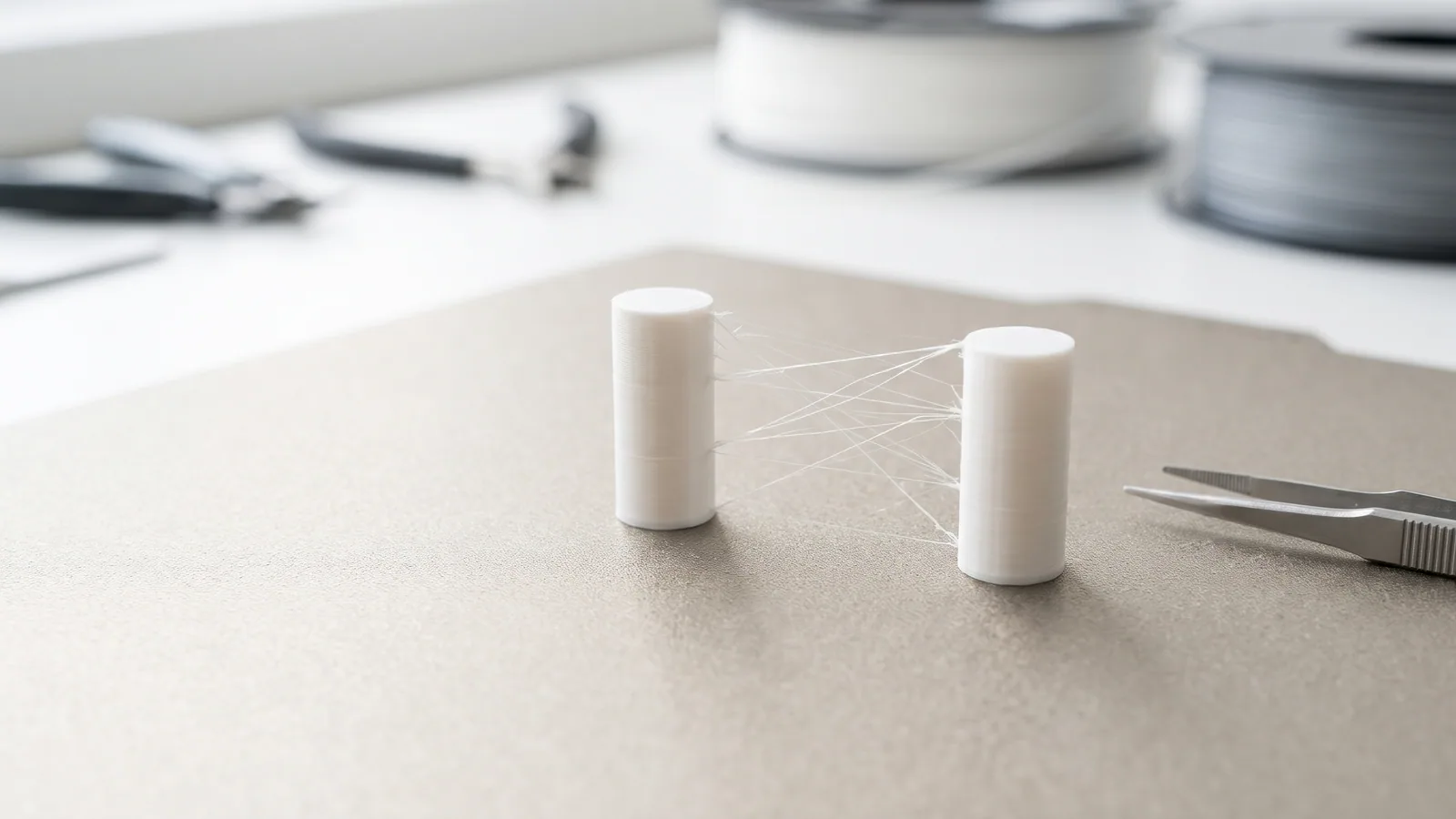
- Layer lines. A printed part is built from thin stacked lines of plastic. The tiny grooves between them trap crumbs, grease and moisture, and you can't scrub them fully clean. That is where bacteria grow.
- What's in the spool. Filament is PLA plus pigments and other additives, and the maker rarely tells you what they are. Prusa's guide notes that some filaments are approved for food contact only in certain colors.
- Heat. PLA starts to soften at roughly 55 to 65 °C. Hot water, a dishwasher or a hot drink can warp it, and you can't sterilize it with heat the way you would a metal bowl.
The short version: PLA is a fine material for things that touch food briefly, dry and cool. It is a poor material for anything that holds food for a long time, gets wet, gets hot, or gets used every day.
Which 3D prints can touch food?
Think of it as a ladder. The less contact, the safer the print. Here is how common holiday prints line up.
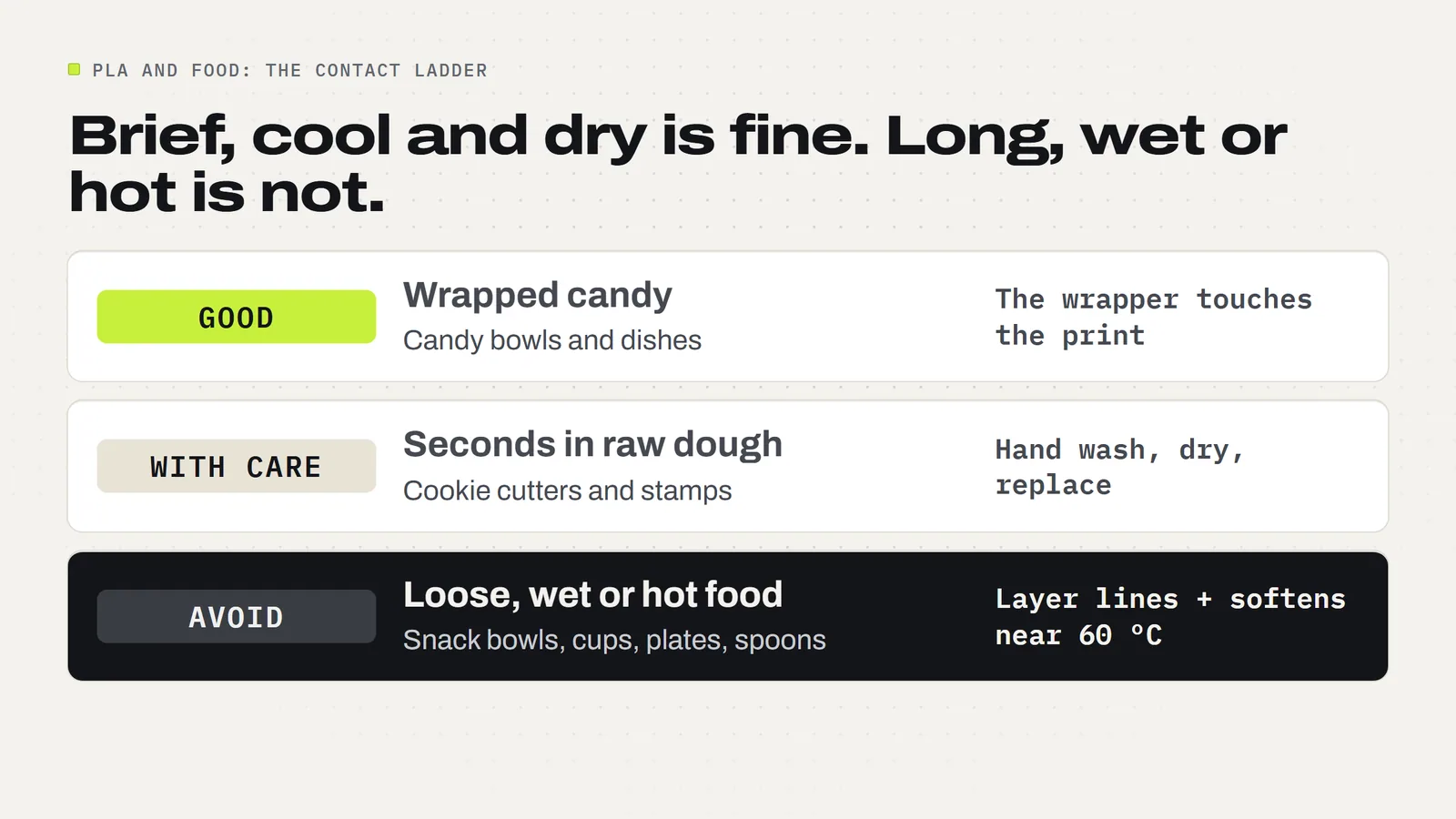
| How it touches food | Our take | |
|---|---|---|
| Candy bowl or dish | Wrapped candy only | Good. The wrapper is the food surface, not the print. |
| Cookie cutter | A few seconds in cool, raw dough | Fine with care: wash by hand, dry well, replace when worn. |
| Cookie stamp | A quick press on raw dough | Same as a cutter. Dust with flour so it lifts clean. |
| Bowl for loose snacks | Dry food, hours at a time, shared hands | Avoid, or line it, or seal it with a food-safe coating. |
| Cup, mug or plate | Wet or hot food, every day | Avoid. Buy a ceramic or steel one. |
| Spoon, spatula, straw | Mouth contact, hot food, constant washing | Avoid. |
Wrapped candy is the easy case, which is why every candy bowl and dish in our catalog says "for wrapped candy only" on its page: the Cornucopia Candy Bowl for Thanksgiving, the Santa Sleigh Candy Dish for Christmas and the Tentacle Cauldron for Halloween.
Are 3D printed cookie cutters safe?
For home baking, yes, if you treat them as a short-contact tool and not a forever tool. A cutter touches cool raw dough for a few seconds and then the cookies go into an oven far hotter than anything the plastic ever sees. Prusa's own guidance puts cookie cutters in the acceptable group, with the warning that layer lines collect dough and bacteria over time, so you should throw them out after a while.
The habits that matter:
- Start clean. Print with a fresh, dry spool and keep the part off dusty surfaces.
- Use flour. A dusting of flour on the cutter and stamp keeps dough out of the grooves.
- Wash by hand, right away. Warm (not hot) soapy water and a soft brush, then rinse and let it dry fully. No dishwasher, no boiling water.
- Replace them. When the edge looks rough or the grooves stay stained, print a new one. That's the real advantage of printing your own.
Our Christmas Cookie Cutters are built around exactly that use: four outline cutters (gingerbread man, tree, snowflake, mitten) with matching stamps, printed in one color with no supports. The model page recommends a food-safe PLA and hand washing in warm water, with no dishwasher, oven or boiling water.
How much does a fresh set of cutters cost to print?
Very little, which is why "replace them every season" is realistic advice rather than a chore. These are Bambu Studio estimates from our own project for a Bambu Lab P2S.
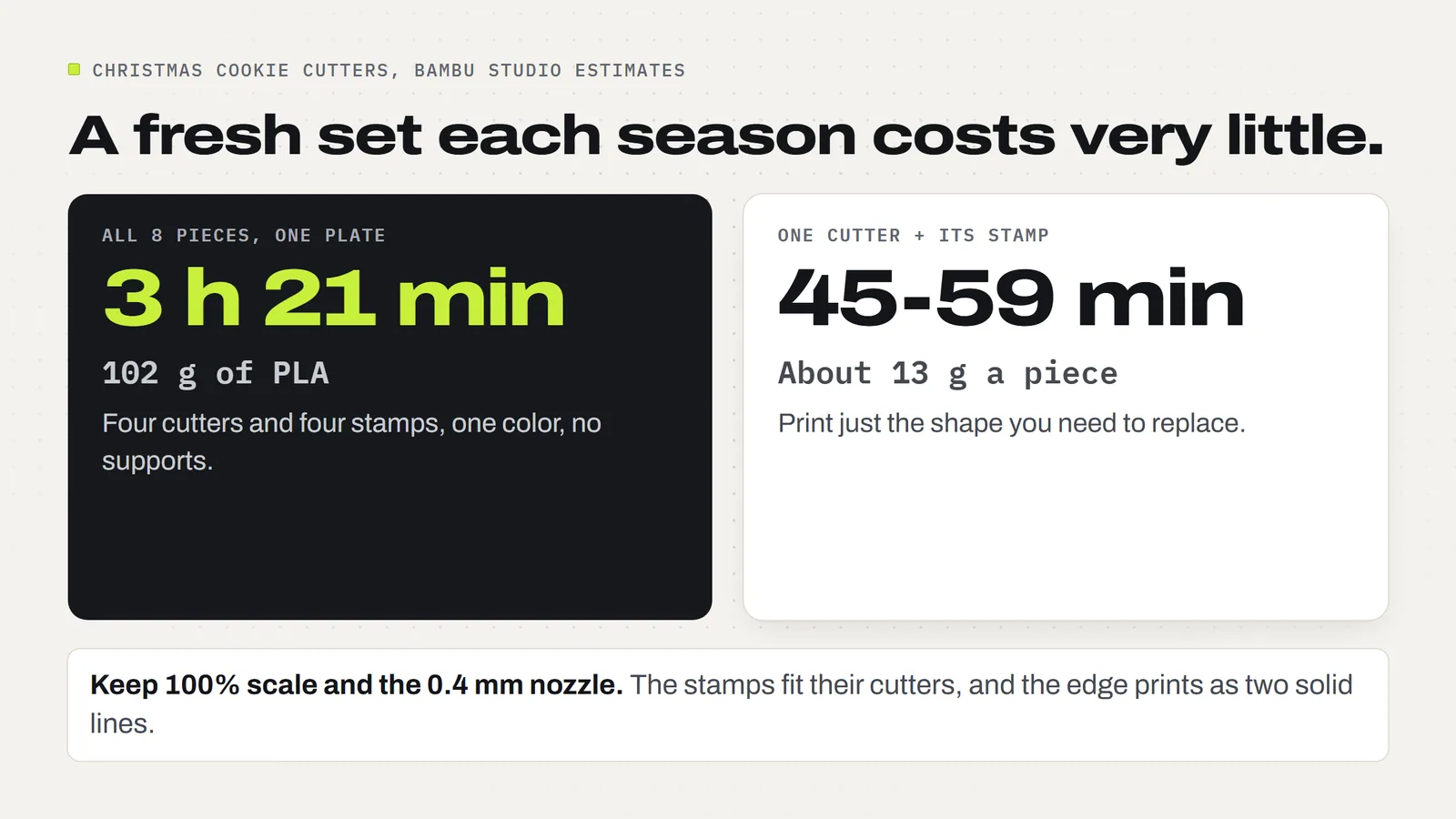
All eight pieces (four cutters and four stamps) take about 3 h 21 min and 102 g of PLA, around 13 g per piece. One cutter and its stamp take 45 to 59 minutes. At 102 g, a whole set uses about a tenth of a 1 kg spool and well under an hour of printing per shape, so a fresh set each December is easy to justify.
Two settings keep the cutting edge clean: leave the scale at 100% so each stamp still fits its cutter, and keep the 0.4 mm nozzle and saved wall widths, so the thin edge prints as two continuous lines with no gaps for dough to sit in. The 3MF project already has both saved; if you're new to opening one, our Bambu Studio beginner's guide walks through it.
What does "food safe filament" actually mean?
When a spool is sold as food safe, it usually means the maker states the raw materials (resin and pigments) meet food contact rules. That is useful: it rules out the unknown-additive problem. It doesn't fix the other two. A print from food safe filament still has layer lines and still softens in hot water.
So a food safe spool is the right choice for a cookie cutter, and it's what our cutter page recommends. It doesn't turn a printed mug into a dishwasher-safe mug.
Is PETG food safe?
PETG is a close cousin of the PET plastic used in water and soda bottles, and Prusa's food-safety guide names natural, uncolored PETG as the best bet among common filaments. It also handles heat better than PLA. But it has the same layer lines, and colored PETG has the same unknown pigments as colored PLA. For a holiday candy bowl or cookie cutter, PLA is fine; PETG is worth it if a print will sit somewhere warm, not because it suddenly makes the print safe for every food. For which spool suits which item you sell, see PLA vs PETG for things you'll sell.
Does the nozzle matter?
It can. Standard brass nozzles wear as they print, and some brass contains small amounts of lead. Prusa's guide says a plain brass nozzle is not considered food safe and suggests stainless steel or titanium if food contact is the goal. Check what your printer's nozzle is made of in its spec sheet before you print cutters.
Can you make a 3D print food safe with a coating?
Partly. A coating of food-safe epoxy fills the layer lines and leaves a smooth surface you can actually wash. That fixes the bacteria problem for things like a snack bowl. It adds cost and time, the coating must be fully cured as its maker directs, and it doesn't raise PLA's softening point, so hot food and dishwashers are still out.
For most holiday prints there's an easier answer: keep the food wrapped. A candy dish full of foil chocolates or wrapped peppermints never needs a coating at all.
Selling candy bowls and cookie cutters you print
Candy dishes and cookie cutters sell well at fall and Christmas craft fairs, and our license lets you sell the physical prints you make from our designs, with no limit and no royalty. You can't share or resell the files themselves.
Describe what you sell honestly: "for wrapped candy" on a bowl, "hand wash only, no dishwasher" on a cutter, and leave out promises like "food safe" that a printed part can't really keep. Our guide to selling 3D prints covers the rest, and how to price 3D prints works through the math. For more holiday ideas, see Christmas 3D prints to make and sell and Thanksgiving 3D prints.
The bottom line
PLA is safe for brief, cool, dry contact: wrapped candy in a printed bowl, a cookie cutter pressed into dough and washed by hand. It is not a good choice for anything that holds loose food for hours, gets wet or hot, or goes in the dishwasher. Print kitchen tools with a fresh food safe spool, wash them gently, and print a new set when they wear. Every design we sell, including the cookie cutters and the candy dishes, is on our designs page, and the FAQ covers what's in each download.
Designs from this guide
 $3.79
3ML-033 · Cookie cutters
Christmas Cookie Cutters
Four Christmas cookie cutters, each with a matching stamp that presses in the details: gingerbread man, Christmas tree, snowflake and mitten. STL + 3MF · 2.5 MB View model $3.79
3ML-017 · Candy bowl
Cornucopia Candy Bowl
A woven-look cornucopia horn that holds wrapped candy, with a curled tail and a harvest cluster that hooks over the rim. STL + 3MF · 12 MB View model $3.79
3ML-032 · Candy dish
Santa Sleigh Candy Dish
Santa's sleigh as a candy dish: a deep red tub with raised swirls, a snowy ivory rim and curled gold runners, printed in one piece. STL + 3MF · 5.1 MB View model $3.79
3ML-003 · Candy bowl
Tentacle Cauldron
A clawed cauldron candy bowl with a purple tentacle that climbs out over the rim. STL + 3MF · 19 MB View modelQuestions
Is PLA food safe?
The plain resin is used in food packaging, and several PLA resins are on the FDA's food contact inventory. A printed part is different: layer lines trap bacteria, filament pigments are unknown, and PLA softens around 55 to 65 °C. Use it for brief, cool, dry contact only.
Are 3D printed cookie cutters safe to use?
For home baking, yes, as a short-contact tool. Dust them with flour, wash by hand in warm soapy water right after use, dry them fully and print new ones when the edge gets rough. No dishwasher or boiling water.
Can I put candy in a 3D printed bowl?
Wrapped candy, yes: the wrapper is the food surface. Loose candy or snacks sitting in the bowl for hours is not a good idea, because crumbs and grease collect in the layer lines. Every candy bowl and dish we sell is for wrapped candy only.
Can PLA go in the dishwasher?
No. PLA starts to soften at roughly 55 to 65 °C, and a hot wash or drying cycle can warp it. Wash PLA prints by hand in warm, not hot, water.
Is PETG food safe?
PETG handles heat better than PLA, and Prusa names natural, uncolored PETG as the best bet among common filaments. It still has layer lines, and colored PETG has unknown pigments, so the same brief-contact rule applies.
What is food safe filament?
A spool whose maker states the resin and pigments meet food contact rules. It removes the unknown-additive problem, but a print from it still has layer lines and still softens in hot water, so it isn't a dishwasher-safe dish.
Does a brass nozzle matter for food prints?
It can. Brass nozzles wear as they print and some brass contains small amounts of lead. Prusa suggests a stainless steel or titanium nozzle for prints meant to touch food. Check your printer's spec sheet.
How do you make a 3D print food safe?
A cured coat of food-safe epoxy fills the layer lines so the surface can be washed properly. It doesn't raise PLA's softening point, so hot food and dishwashers are still out. For candy bowls, keeping the candy wrapped is simpler.
Sources
Filed under Printing and slicing