PLA vs PETG for Things You'll Sell: Lanterns, Bowls and Outdoor Decor
Most guides compare PLA and PETG for engineering parts. This one sorts the things people actually print to sell, from ornaments and lanterns to bag clips and gutter light clips, by which spool to load.
Most "PLA vs PETG" guides are written for engineers choosing a material for a bracket. If you print to sell, the question is narrower: which spool do you load for an ornament, a lantern, a candy bowl, a bag clip or a clip that lives on the gutter all December? The answer for most of what sells at a holiday fair is PLA. For a short list of jobs, PETG is the better buy, and it is worth knowing which ones before a customer brings a warped or snapped print back to your table.
This guide uses the two most common spools on Bambu Lab printers, Bambu's PLA Basic and PETG Basic, and their published data sheets, so every number below is a real one. It also shows what our own designs are set up for, and why two of them ship as PETG projects.
Is PETG better than PLA?
Not overall. They are good at different things.
- PLA is stiff, prints easily at lower temperatures, gives crisp detail and sharp color edges, and rarely fails. It is the default filament for decor, figures, ornaments and anything that sits on a shelf indoors.
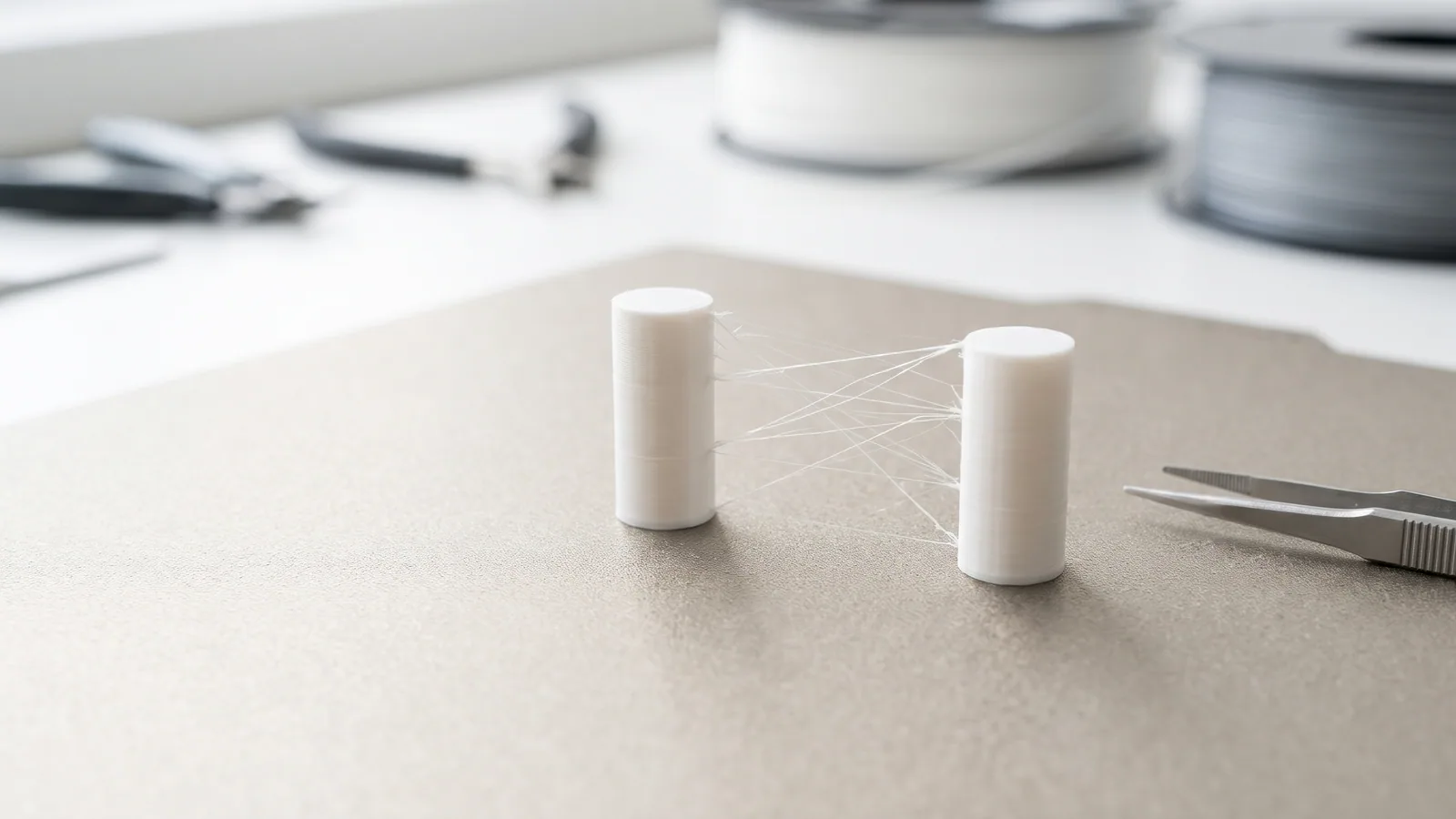
- PETG is tougher and a little springier. It bends before it breaks, takes more heat before it softens, and copes better with sun and weather. The trade is a fussier print: hotter nozzle, hotter plate, more stringing (thin hairs of plastic between parts) and a spool that soaks up moisture from the air faster, so it needs drying.
So "better" depends on the job. If a print has to flex, hold weight or live outdoors, PETG wins. If it has to look sharp and sit indoors, PLA wins, and it is faster and easier to get right on the first try.
PLA vs PETG: the numbers side by side
These figures come from Bambu Lab's technical data sheets (version 2.0) for PLA Basic and PETG Basic. Other brands will be close but not identical, so check your own spool's sheet if a number matters.
| PLA Basic | PETG Basic | |
|---|---|---|
| Starts to soften (glass transition) | 60 °C | 68 °C |
| Bends under light load (heat deflection, 0.45 MPa) | 57 °C | 69 °C |
| Pull strength along the layers | 39 MPa | 48 MPa |
| Nozzle temperature | 190 to 230 °C | 240 to 270 °C |
| Plate temperature | 35 to 45 °C | 65 to 75 °C |
| Drying before printing | 55 °C, 8 hours | 65 °C, 8 hours |
| Water it can absorb (25 °C, 55% humidity) | 0.43% | 0.32% |
| Density (how heavy a print is) | 1.24 g/cm³ | 1.25 g/cm³ |
Two things stand out for sellers. First, the heat gap is real but small: PETG holds its shape about 10 to 12 °C longer than PLA, not 100. Second, density is almost the same, so the same model weighs about the same in either material, and your filament cost per item barely moves.
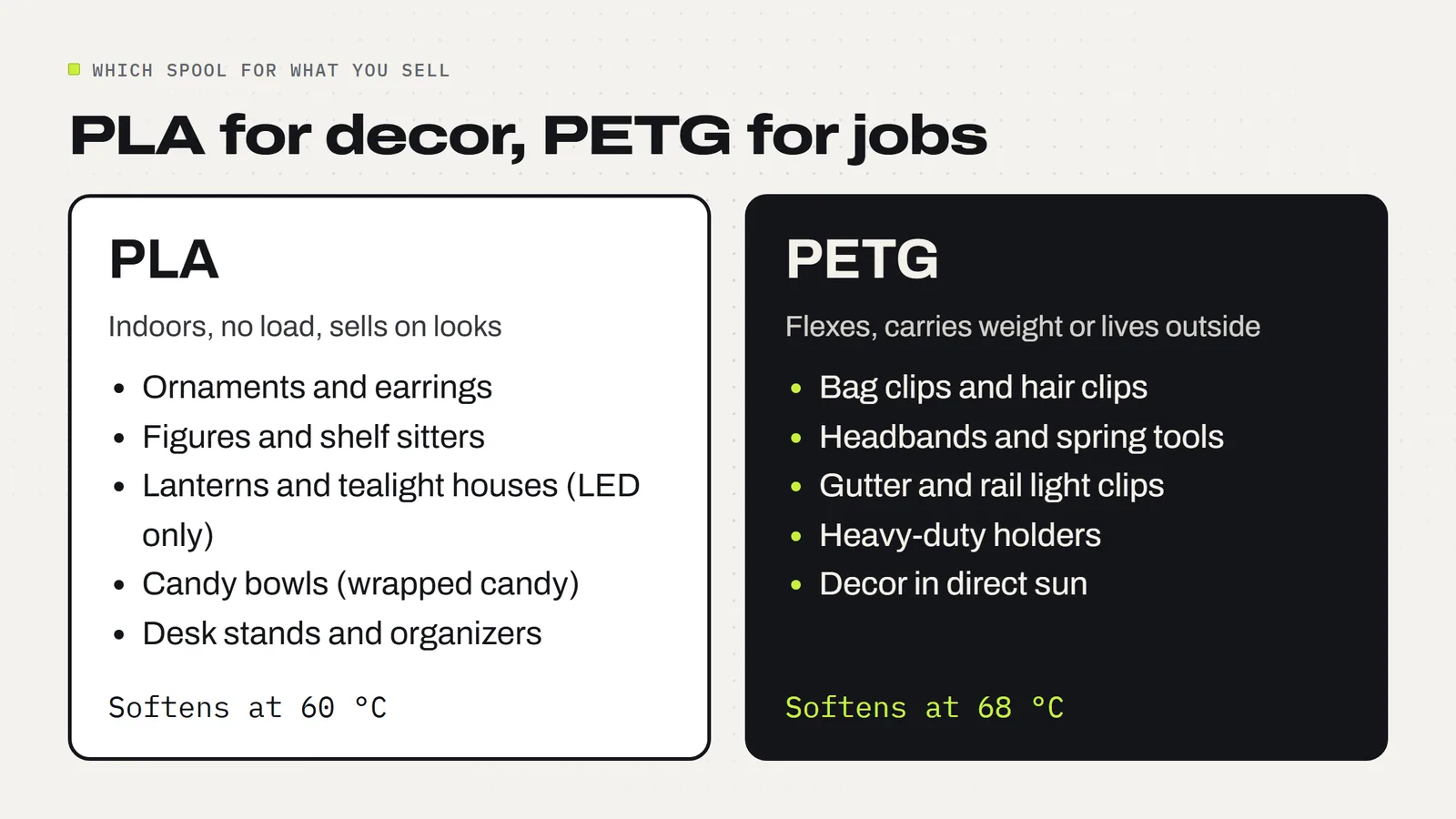
Which filament should you use for what you sell?
Go item by item. Here is how the common holiday sellers sort out.
Ornaments, figures, earrings and shelf decor: PLA
These sit indoors, carry no load and sell on looks. PLA gives the cleaner surface, sharper color changes and fewer strings to pick off. Every one of our ornament, earring, figure and shelf-sitter projects is set up for PLA for that reason.
Lanterns and tealight houses: PLA, with LED lights only
A lantern frame with decorative plates, or a tealight house, is indoor decor, so PLA is the normal choice. Our Modular Lantern Frame project is saved for PLA. The rule that matters is the light, not the plastic: use battery LED tealights only. PLA softens at around 60 °C, and PETG's 68 °C is not enough margin for a real flame either. Switching to PETG does not make a printed lantern candle-safe. Our Christmas lantern guide covers lighting in more detail.
Candy bowls and dishes: PLA, wrapped candy
Our Cornucopia Candy Bowl and the other candy dishes are PLA projects. PETG is sometimes sold as the "food safe" option, but a printed PETG bowl still has layer lines that trap crumbs, and colored spools still carry pigments you can't check. The same rule applies to both: wrapped candy only, and don't call a printed bowl food safe when you sell it. The full reasoning is in Is PLA food safe?
Clips, headbands and anything that flexes: PETG
This is where PETG earns its place. A print that bends every time it's used, like a bag clip, a snap hair clip or a headband, will last longer in PETG, because PETG gives a little before it cracks and keeps its spring. Our guides say so plainly: the Bag Clips recommend PETG for toughness in the kitchen, the Bow Hair Clip recommends it "for a springier clip and repeated use", and the Pumpkin Bopper Headband notes that PETG "tolerates stretching better". Our Bow Maker Clip, a ribbon tool with a built-in spring, ships set up for PETG from the start.
Outdoor decor and light clips: PETG (or ASA)
Rain is not the problem for PLA outdoors. Sun is. A PLA part on a sunny gutter can get warm enough to soften and slowly creep out of shape. Our Christmas Light Clips are one of the two designs we ship as PETG projects for exactly that reason; the guide says "PLA softens in sun and can creep off the gutter." PETG also holds up to sunlight better than plain PLA. For parts that stay outside all year, ASA is better again, but it needs an enclosed printer, so PETG is the practical choice for seasonal decor on most home setups.
Holders that carry weight: PETG
Stiff is not the same as tough. PLA is stiff, which is great for a stand that only holds a phone or a remote. For something that carries a heavy load for months, PETG is safer. Our Pegboard Drill Holder ships with PLA settings, and its guide says to use PETG for heavy drills and sustained loading.
Is PLA waterproof?
PLA doesn't dissolve or go soft in water, and a splash or a rain shower won't hurt a PLA print. It does take up a little moisture: Bambu's sheet puts PLA Basic at 0.43% and PETG Basic at 0.32% at room conditions. The bigger issue for anything that holds water is the print, not the plastic. Layer lines and thin walls can let water seep through, so a vase or planter needs settings meant for it (more walls, or a vase mode print) whichever filament you use.
For a seller the practical rule is simple: an indoor PLA piece that gets wiped with a damp cloth is fine. A piece that sits in water, or outside in the sun, should be PETG.
How hot can PLA and PETG get before they soften?
On Bambu's data sheets, PLA Basic starts to soften at 60 °C and bends under a light load at 57 °C. PETG Basic manages 68 °C and 69 °C. In everyday terms:
- Fine for both: a living room, a shelf, a mantel over a fireplace that isn't lit, a cold porch.
- PETG only: a sunny window, a gutter or porch rail in direct sun.
- Neither: open flame, a hot fireplace surround, the dishwasher, boiling water.
If a customer asks how much heat a print can take, give them the plain version: room temperature is fine, sun and hot water are not for PLA, and nothing printed in either material goes near a flame. Don't promise more than the material can do.
What our designs are set up for
We checked the saved filament in every 3MF project across our live catalog: 97 designs that ship a 3MF project (one more ships STL only). 95 are set up for PLA, and 2 for PETG. Four of the PLA designs go further and tell you in their START_HERE guide that PETG is the better material for their job.
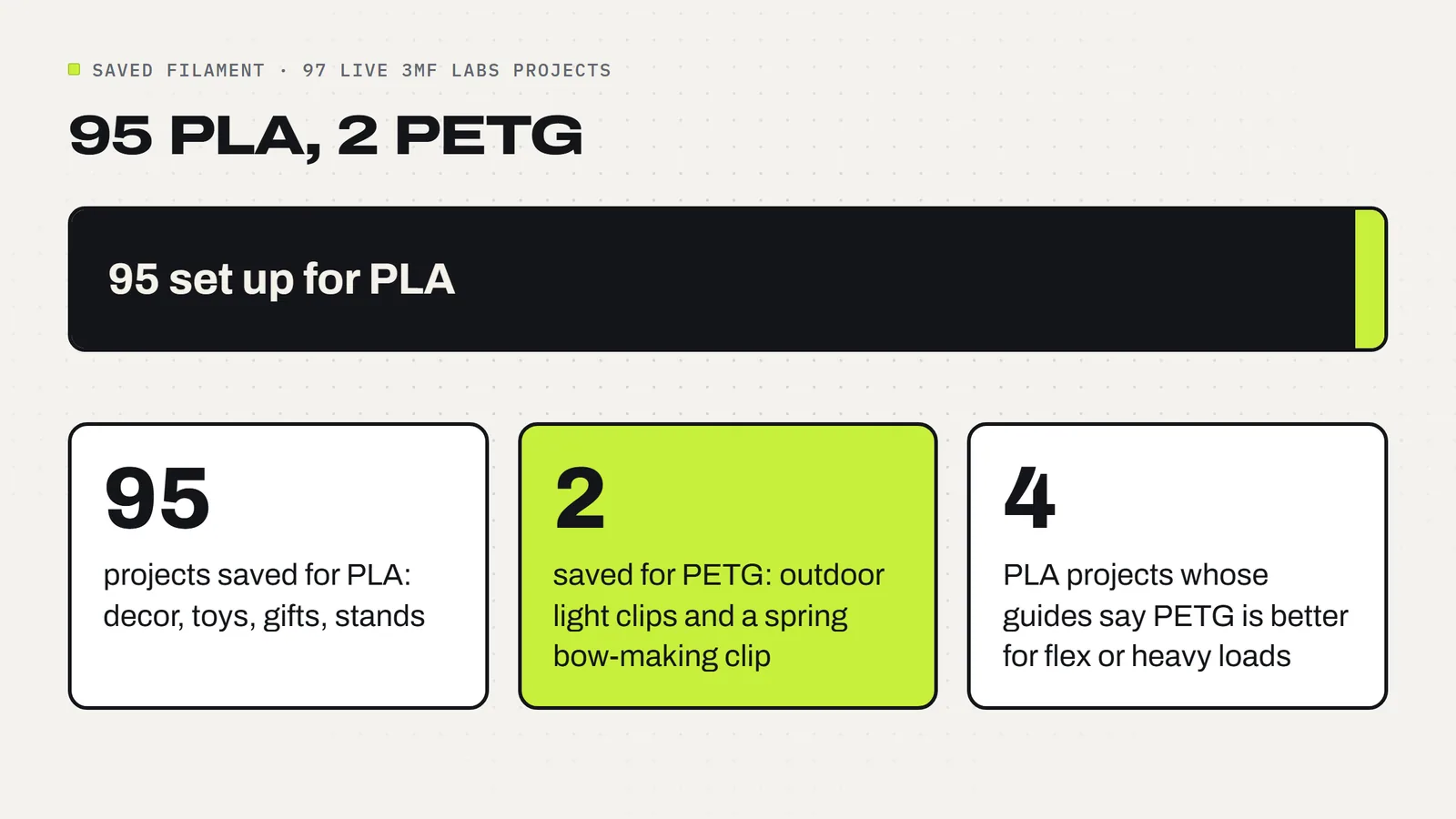
That split is a fair picture of what sells at a holiday table: almost all decor, toys and gifts, with a few functional pieces where toughness matters more than a crisp edge. It also means a PLA-only seller can print nearly everything here without buying a second material.
Does PETG cost more or take longer to print?
Per item, barely. The two materials weigh almost the same, so a print uses almost the same grams either way, and a small item uses so little filament that the spool price hardly shows in its cost. Our light clips are a good example: one gutter clip in PETG takes 18 minutes and 2.38 g, and a full plate of 20 gutter clips takes 178 minutes and 47.52 g. The Bow Maker Clip, both parts on one PETG plate, takes about 1 hour 42 minutes and 32.70 g.
The real cost of PETG is attention. It strings more, so you spend time cleaning parts. It needs drying, so a spool left out in a humid garage can ruin a batch. And it sticks hard to a smooth plate. Bambu's sheet recommends glue on the plate as a release layer. Our PETG projects are saved for the textured PEI plate at 70 °C.
How do you print a PLA project in PETG?
You can print any PLA project in PETG, but you have to change the settings, not just the spool. In Bambu Studio:
- Open the 3MF as a project, as usual (see Bambu Studio for beginners).
- In the filament list, change each filament from a PLA profile to a PETG profile that matches your spool. This is what sets the hotter nozzle and plate temperatures. Our PLA projects run the nozzle at 220 °C; our PETG projects run it at 250 to 255 °C.
- Pick the plate you'll print on. Textured PEI is the easy choice for PETG.
- Slice again and check the preview before you print.
Two rules from our guides: never print PLA with PETG temperatures or PETG with PLA temperatures, and never mix PLA and PETG in one multicolor print. They need different temperatures, so one of the two would always print at the wrong one.
Dry the PETG first if the spool has been open for a while. Bambu's sheet gives 65 °C for 8 hours. A damp spool is the first thing to check when PETG strings, and our stringing guide covers the check and the fixes that come after it.
Can you sell what you print in either material?
Yes. With a 3MF Labs design, the license lets you sell the physical prints you make, in PLA, PETG or anything else, with no limit and no royalty. You can't share or resell the files themselves. For pricing, see how to price 3D prints, and for everything else about selling, selling 3D prints.
If you only own one material this season, make it PLA and print the decor. Add a spool of PETG when you start selling clips, holders or anything that goes outside. Browse the designs to see which material each one is set up for, and the FAQ if you're new to 3MF projects.
Designs from this guide
 $2.49
3ML-045 · Light clips
Christmas Light Clips
Four one-piece clips for hanging outdoor string lights on gutters, shingles and round porch rails, with no nails, screws or tools. STL + 3MF · 6.2 MB View model $2.49
3ML-083 · Bag clips
Bag Clips
Snack bag clips in three sizes that print in one go with the hinge already inside: fold them shut once and they snap closed. STL + 3MF · 1.2 MB View model $2.49
3ML-087 · Drill holder
Pegboard Drill Holder
A one-piece cordless drill holder that hooks straight onto SKADIS-style pegboard: a cradle for the drill, a tray for the spare battery and four bit holes, with no screws. STL + 3MF · 151 KB View model $2.49
3ML-012 · Lantern frame
Modular Lantern Frame
The Modular Lantern's frame, roof and carry handle. Print it once, then slide in a set of panels for every season. STL + 3MF · 2.0 MB View model $3.79
3ML-017 · Candy bowl
Cornucopia Candy Bowl
A woven-look cornucopia horn that holds wrapped candy, with a curled tail and a harvest cluster that hooks over the rim. STL + 3MF · 12 MB View model Free
3ML-035 · Craft tool
Bow Maker Clip
A slim clip for making boutique hair bows: it holds your folded ribbon while you tie the center through its open-ended slot. STL + 3MF · 179 KB View modelQuestions
Is PETG better than PLA?
Not overall. PETG is tougher, springier and takes a little more heat (68 °C against 60 °C on Bambu's sheets). PLA prints more easily, gives sharper detail and is the better choice for indoor decor. Pick by the job, not the label.
Is PETG stronger than PLA?
In pull strength along the layers, yes: Bambu lists 48 MPa for PETG Basic and 39 MPa for PLA Basic. More useful for sellers, PETG bends before it breaks, so clips and springy parts last longer. PLA is stiffer.
Is PLA waterproof?
PLA doesn't dissolve or soften in water, so rain or a damp cloth won't hurt it. Printed parts can still leak through thin walls or layer lines, so anything that holds water needs settings made for it, whichever filament you use.
Can PLA be used outdoors?
For a few days in the shade, yes. In direct sun, PLA can soften and creep out of shape. Our Christmas Light Clips ship as PETG projects for that reason: their guide says PLA softens in sun and can creep off the gutter.
Is PETG safe for a candle lantern?
No. PETG softens at about 68 °C, only a little higher than PLA. Use battery LED tealights in any printed lantern, whichever filament it is made from.
Can I print a PLA 3MF project in PETG?
Yes. Open it as a project, change each filament to a PETG profile so the nozzle and plate temperatures change, then slice again. Don't print PETG with PLA temperatures, and don't mix PLA and PETG in one multicolor print.
Does PETG need to be dried?
Often, yes. A damp PETG spool strings badly. Bambu's data sheet recommends 65 °C for 8 hours before printing, and storing it sealed with desiccant.
Can I sell prints made in PETG?
Yes. The 3MF Labs license lets you sell the physical prints you make in any material, with no limit and no royalty. You can't share or resell the files.
Sources
Filed under Printing and slicing