How Much Does It Cost to 3D Print Something? Real Numbers From Our Designs
A small print costs cents at home and many times that from a service. Here is the simple sum, run on the listed times and weights of 74 real designs.
Ask how much a 3D print costs and you get two very different answers. If you own a printer, a small item costs less than a cup of coffee in plastic and electricity. If you pay someone else to print it, the same item can cost four to twenty times that. Both are true, and both are easy to work out once you know the grams and the hours.
Most articles on this give you a range so wide it doesn't help. So we used our own numbers instead. We took the print time and filament weight listed on the pages of our live 3MF Labs designs, ran them through the same simple sum, and looked at what came out. Spool prices and printer prices below were checked on 5 November 2026, and they do change.
One note before the numbers: this guide covers what a print costs you. If you want to know what to charge for it, read how to price 3D prints you sell.
How much does it cost to 3D print something at home?
Usually between a few cents and a few dollars. Two costs show up on every print, and you can work out both on a phone calculator:
- Filament: grams × your spool price ÷ 1,000. A $20 spool holds 1 kg, so each gram costs 2 cents.
- Electricity: hours × 3.6 cents. That comes from the 200 watts Bambu Lab lists for the P2S while printing PLA, times the 18.2 cents per kilowatt-hour the U.S. Energy Information Administration expects homes to pay on average in 2026. Your rate is on your electric bill.
Here are real designs through that sum, with cost meaning filament plus electricity. The times and weights are the ones on each model page.
| Design | Time | Grams | Cost |
|---|---|---|---|
| Bow Hair Clip | About 25 min | About 5 | $0.12 |
| Turkey Fidget Spinner | 1 h 19 min | 38 | $0.81 |
| Peppermint Snake (large) | 4 h 51 min | 55 | $1.28 |
| Articulated Cat (two colors) | 3 h 56 min | 86 | $1.86 |
| Christmas Train (all three cars) | 5 h 26 min | 165 | $3.50 |
| Modular Lantern Frame | 18 h 10 min | 361 | $7.88 |
| Monitor Stand | 36 h 34 min | 1,082 | $22.97 |
Filament is nearly all of that cost. On the typical design, electricity is about 8% of the total. If you only remember one number from this guide, remember the weight. The lantern frame figure is the frame alone: its decorative plates are a separate print, and a set like the North Pole Lantern Panels adds 3 h 55 min and 71 g, or $1.56.
What does a typical 3D print cost? Our numbers from 74 designs
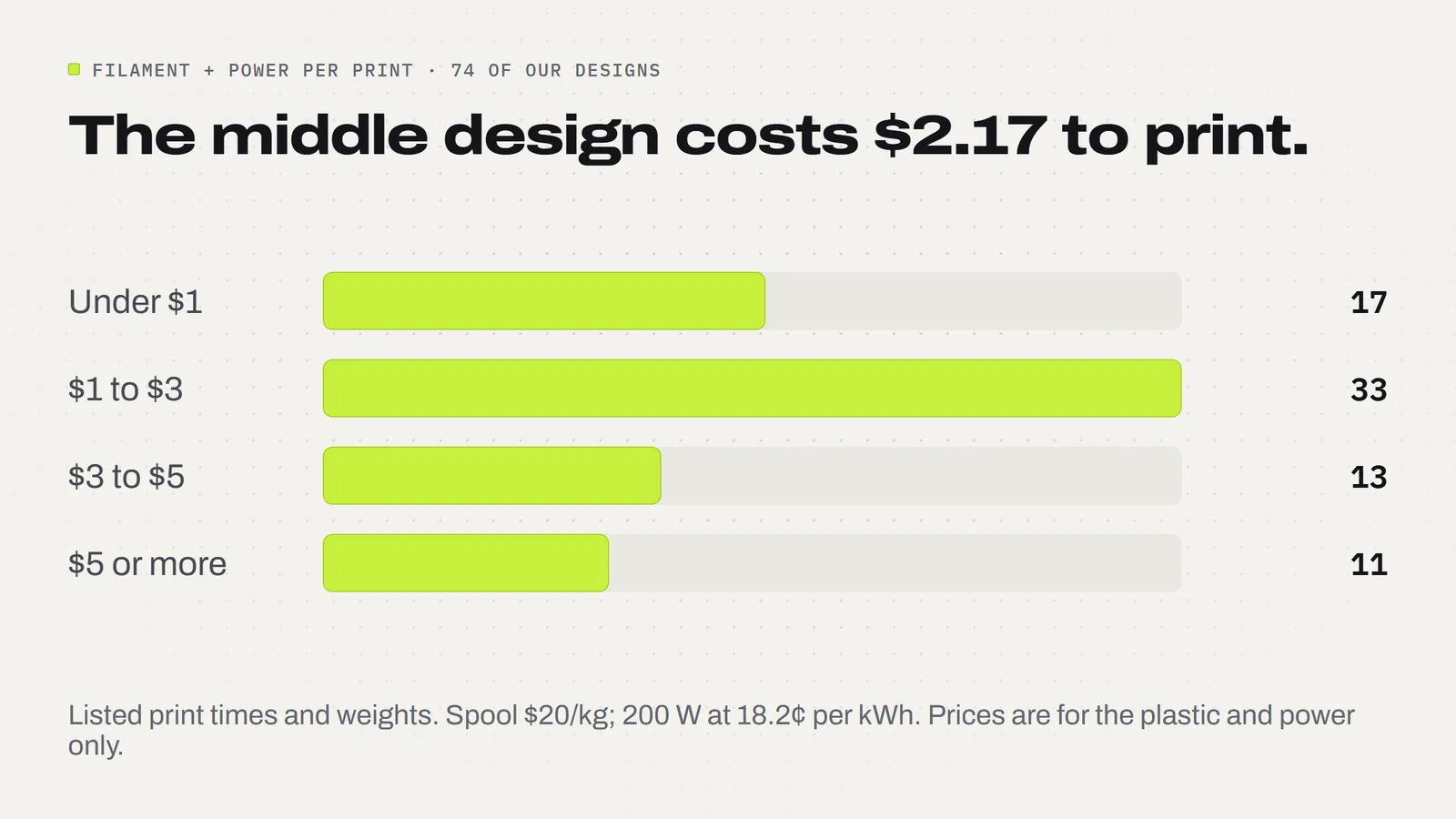
Of the 101 designs live on 3MF Labs today, 74 list a single print time and a single filament weight on their page. The others give a range or don't list both numbers that way, so we left them out. For the 74, we used whatever layout the page lists as its main number.
The median design (the one in the middle if you line them all up) uses 101 g of filament, takes about 4 hours 29 minutes and costs $2.17 in plastic and power, at $20 a spool. So one 1 kg spool makes about ten prints of that size.
Another way to read the same data: half our designs use about 20 g of filament per hour of printing, or more. That works out at roughly 44 cents per printer hour in plastic and power. It's a rough guide for a print you haven't sliced yet, and it won't hold for every shape. A solid chunky part eats filament faster than a fine, detailed one.
How long does it take to 3D print something?
Anywhere from under half an hour to a day and a half, and the middle of our range is about four and a half hours. Here's how the same 74 designs split:
- Under 2 hours: 16 designs, mostly small items like fidget spinners and sliders
- 2 to 5 hours: 25 designs
- 5 to 10 hours: 19 designs
- 10 hours or more: 14 designs, mostly bigger builds
Almost all of our projects are saved with a profile for the Bambu Lab P2S. Another printer or profile will give you a different time, so treat these as a guide and slice the file yourself for your real number. That takes a minute in a free slicer (the app that prepares a file for printing), and our Bambu Studio beginner guide shows you where to look. The time and grams appear as soon as it's sliced.
Time is mostly unattended, so a 10-hour print isn't 10 hours of your day. It does matter if you're printing a lot of items for a deadline, because one printer can only do one plate at a time.
What makes a 3D print cost more?
Four things move the number, in roughly this order:
- Size. Double the size of a shape in every direction and its volume grows eight times. Filament use doesn't always grow that fast, because much of the inside is hollow, but it climbs quickly. This is why a large stand costs more than a small toy by a wide margin.
- Extra colors. On a single-nozzle printer, each color change pushes some filament out to clear the old color. Our Articulated Cat is 3 h 6 min and 73 g in one color, and 3 h 56 min and 86 g in two. That second color adds 50 minutes and 13 g. See how color changes work and whether you need an AMS.
- Supports and infill. Supports are the throwaway scaffolding under overhangs, and infill is the pattern inside a part. More of either means more plastic and more time. Our guide to adding supports covers the basics.
- The filament you pick. Standard PLA is the baseline here. Specialty filaments usually cost more per spool, so put your own spool price in the sum. PLA vs PETG explains when a different material is worth it.
How much is a spool of filament?
We use $20 for a 1 kg spool in our examples because it's a round number that's easy to swap. On 5 November 2026, the Bambu Lab US store listed PLA Basic at $14.99 for a 1 kg refill and $17.99 with a spool. At $14.99, our median 101 g print drops from $2.02 of plastic to $1.51.
Filament prices move around, so use what you actually paid. Divide by 1,000 and you have your cost per gram for good.
What costs don't show up in the slicer?
Filament and power are the part you can read off the screen. Three more costs arrive later:
- Failed prints. A plate that lets go halfway through still used filament. We allow an extra 10% of the filament and power cost. That's our assumption, so keep a tally for a month and use your real figure.
- Machine wear. Nozzles, build plates and belts all wear out. We allow 25 cents per printer hour, also our assumption.
- The file. Plenty of files are free. A paid design is a one-time cost that shrinks with every print you make from it.
Run the large Peppermint Snake through it: $1.28 for plastic and power, plus $1.21 for wear (4.85 hours at 25 cents), plus 13 cents for failed prints. That's $2.62 per print, about double what the slicer's numbers suggest. Wear is the biggest of those additions on a long print, which is why slow, light prints cost more than their grams imply.
How much does it cost to have something 3D printed for you?
Much more per gram, because a service is also paying for its machine, its staff and its overheads. A few published rates for PLA:
- Brigham Young University library: $0.10 per gram for PLA, PETG or ASA
- Northern Arizona University MakerLab: $0.12 per gram for standard PLA, with extra flat fees for shipping, community prints and large jobs
- Maker Portal, an online print service: typically $0.35 per gram of PLA, $5 minimum per order, plus $4 shipping
Campus labs have their own rules on who they print for, so check before you count on one. Many services quote per job from your uploaded file, and some of those prices will land outside this range. Here's how those rates compare with printing at home:
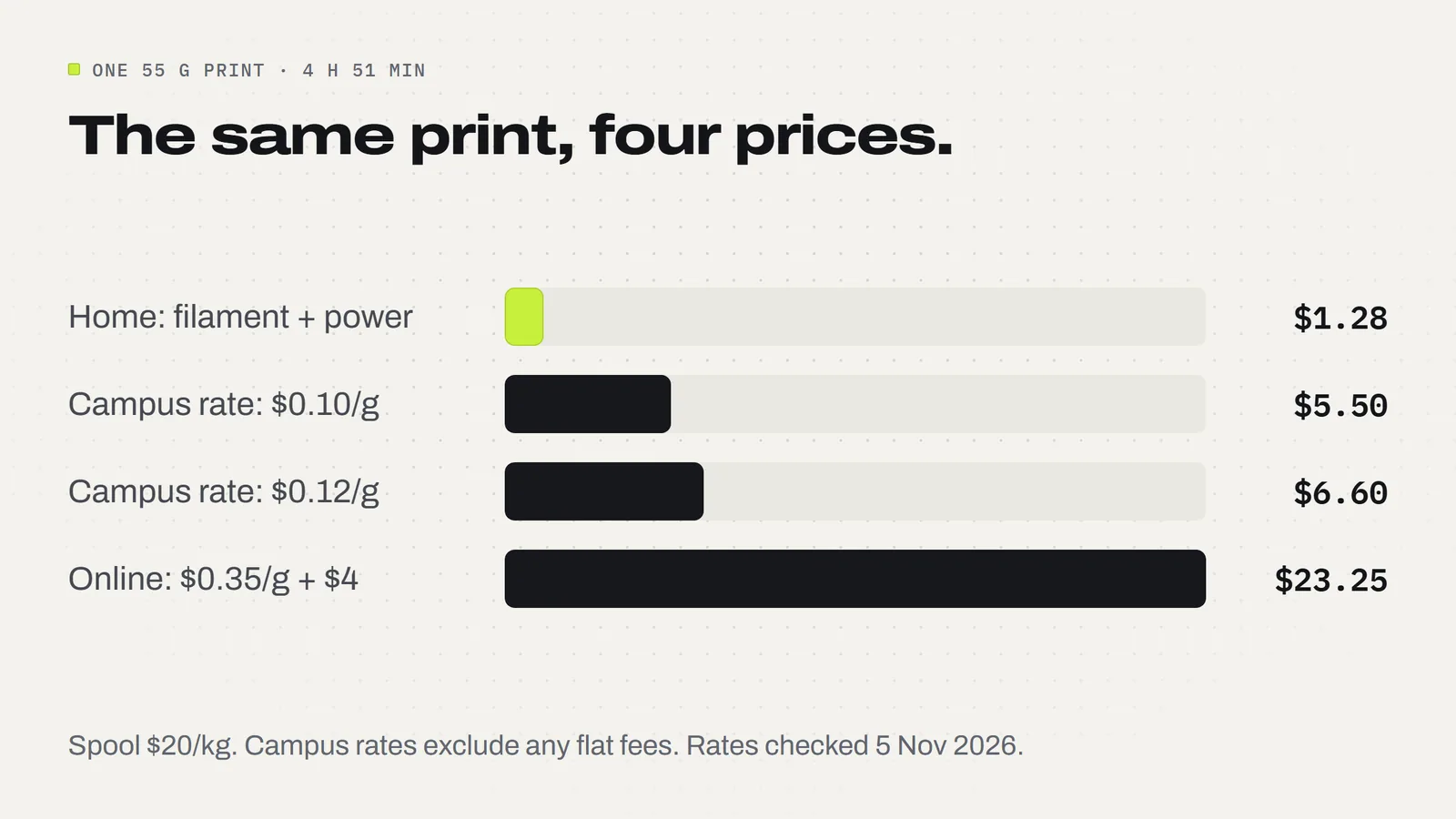
For a 165 g print like the Christmas Train, the same sums give $3.50 at home, $16.50 and $19.80 at the two campus rates, and $61.75 by mail. A service still makes sense for a one-off job. You can also get a material you don't have, or a part bigger than your printer can handle.
Is 3D printing expensive, or is it cheaper to buy a printer?
The running costs are low. The printer is the real expense. On 5 November 2026, the Bambu Lab US store listed the A1 mini at $199 (marked down from $219) and the A1 mini Combo, which adds the AMS lite for multicolor printing, at $299 (down from $329). If you want to check what fits on the smaller printer first, see our A1 mini size guide.
Here's a simple way to think about it, using the 55 g print above. Compared with the $23.25 mail-order price, each print at home saves about $22, so a $199 printer covers itself after about 10 prints. Compared with a $5.50 campus lab, each print saves about $4.22, so it takes about 48. That leaves out wear, failed prints and the hours you'll spend learning the machine, so treat it as a best case. If you only need one or two parts a year, pay a service. If you'd print something most weeks, or you want to sell what you make, the printer tends to win.
If you do sell prints, how to make money with a 3D printer runs the numbers for a whole fair table.
What do you get with a 3MF Labs design?
Every paid design is a one-time purchase from $2.49. The Peppermint Snake is $3.79, so print it ten times and the file adds about 38 cents to each one. Each download has a 3MF project with the plates, colors and settings saved for Bambu Studio, STL files for any other slicer, and a START_HERE guide with print notes. If your printer or slicer is different, our STL vs 3MF guide explains which file to use.
The 3MF Labs license lets you sell the physical prints you make, with no limit and no royalty. You can't share, upload, resell or give away the files or remixes of them.
Pick a design from the full list, check its page for time and grams, and you'll know what it costs you before you press print. The sum takes about ten seconds.
Designs from this guide
 $3.79
3ML-013 · Flexi snake
Peppermint Snake
A wiggly snake made of peppermint candies, with black eyes and a red tongue. It prints in one piece, already joined, so there's nothing to put together. STL + 3MF · 23 MB View model $3.79
3ML-064 · Flexi cat
Articulated Cat
A happy orange tabby that wiggles from its shoulders to the tip of its tail. It prints in one piece, already joined, so there's nothing to put together. STL + 3MF · 4.5 MB View model $2.49
3ML-071 · Fidget spinner
Turkey Fidget Spinner
Eight tail feathers spin around a turkey-face hub. It prints in place in one piece: no metal bearing, no assembly. STL + 3MF · 5.6 MB View model $3.79
3ML-069 · Rolling train
Christmas Train
A chunky Christmas steam train in three pieces: a red locomotive, a green candy wagon and a red caboose. The wheels click on and really roll, and the cars link together with no glue or tools. STL + 3MF · 19 MB View model $2.49
3ML-096 · Hair clip
Bow Hair Clip
A printed snap hair clip with a puffy bow on top, in two sizes: a flexing tongue clicks under a little catch, with no metal clip, pin or glue. STL + 3MF · 2.1 MB View model $2.49
3ML-012 · Lantern frame
Modular Lantern Frame
The Modular Lantern's frame, roof and carry handle. Print it once, then slide in a set of panels for every season. STL + 3MF · 2.0 MB View modelQuestions
How much does it cost to 3D print something?
At home, work out grams × spool price ÷ 1,000, then add about 3.6 cents per hour for electricity. Across 74 of our designs the median print costs $2.17 in filament and power at $20 a spool. The range runs from 12 cents for a small hair clip to about $23 for a large monitor stand.
How much does 3D printing cost per gram?
At home, a $20 spool of 1 kg works out at 2 cents per gram of plastic, and electricity adds a small amount. Published PLA service rates we checked run from 10 cents per gram at a university library to 35 cents per gram at an online service, and some add minimums, shipping or other fees.
How long does it take to 3D print something?
Across 74 of our designs, the median print takes about 4 hours 29 minutes. Sixteen take under 2 hours and 14 take 10 hours or more. Size matters most, and extra colors add time too. Slice the file for your printer to get a real estimate.
How much electricity does a 3D printer use?
Bambu Lab lists the P2S at 200 watts of steady power while printing PLA. At the 18.2 cents per kilowatt-hour the U.S. Energy Information Administration expects for homes in 2026, that is about 3.6 cents an hour. On the typical design in our catalog, electricity is about 8% of the filament and power cost.
Is 3D printing cheaper than buying things?
For small decorative items, the plastic and power are often very cheap: our Turkey Fidget Spinner comes to 81 cents. That leaves out the printer itself, wear, failed prints and your time. Printing is usually better value for items you can't easily buy, or when you'll make many, than for a single cheap household part.
Is it cheaper to buy a 3D printer or use a service?
It depends on how often you print. For a 55 g print, a $199 printer covers itself after about 10 prints against a $23.25 mail-order price, or about 48 against a $5.50 campus lab rate. That best case leaves out wear and failed prints. For one or two parts a year, a service is the better deal.
How many prints can you get from a 1 kg spool of filament?
It depends on the size of the print. Our median design uses 101 g, so a 1 kg spool makes about ten of those. It would make about 200 of our 5 g Bow Hair Clip, in theory, before waste and failed prints, and less than one of our 1,082 g Monitor Stand.
Can I sell prints made from 3MF Labs designs?
Yes. The 3MF Labs license lets you sell the physical prints you make from our designs, with no limit and no royalty. You can't share, upload, resell or give away the files or remixes of them.
Sources
- Bambu Lab Wiki: P2S FAQ (steady-state power, PLA)
- U.S. Energy Information Administration: Short-Term Energy Outlook, electricity (October 2026)
- Bambu Lab US Store: PLA Basic (price checked 5 November 2026)
- Bambu Lab US Store: A1 mini (price checked 5 November 2026)
- Brigham Young University Library: 3D Printers
- Northern Arizona University: Is there a cost to use the 3D printers?
- Maker Portal: On-Demand 3D Printing
Filed under Printing and slicing