How to Dry Filament (and How to Tell It Is Wet)
A spool that printed perfectly last month can start popping, stringing and printing rough without a single setting changing. It has taken on water from the air. Here is how to tell, and how to dry it safely.
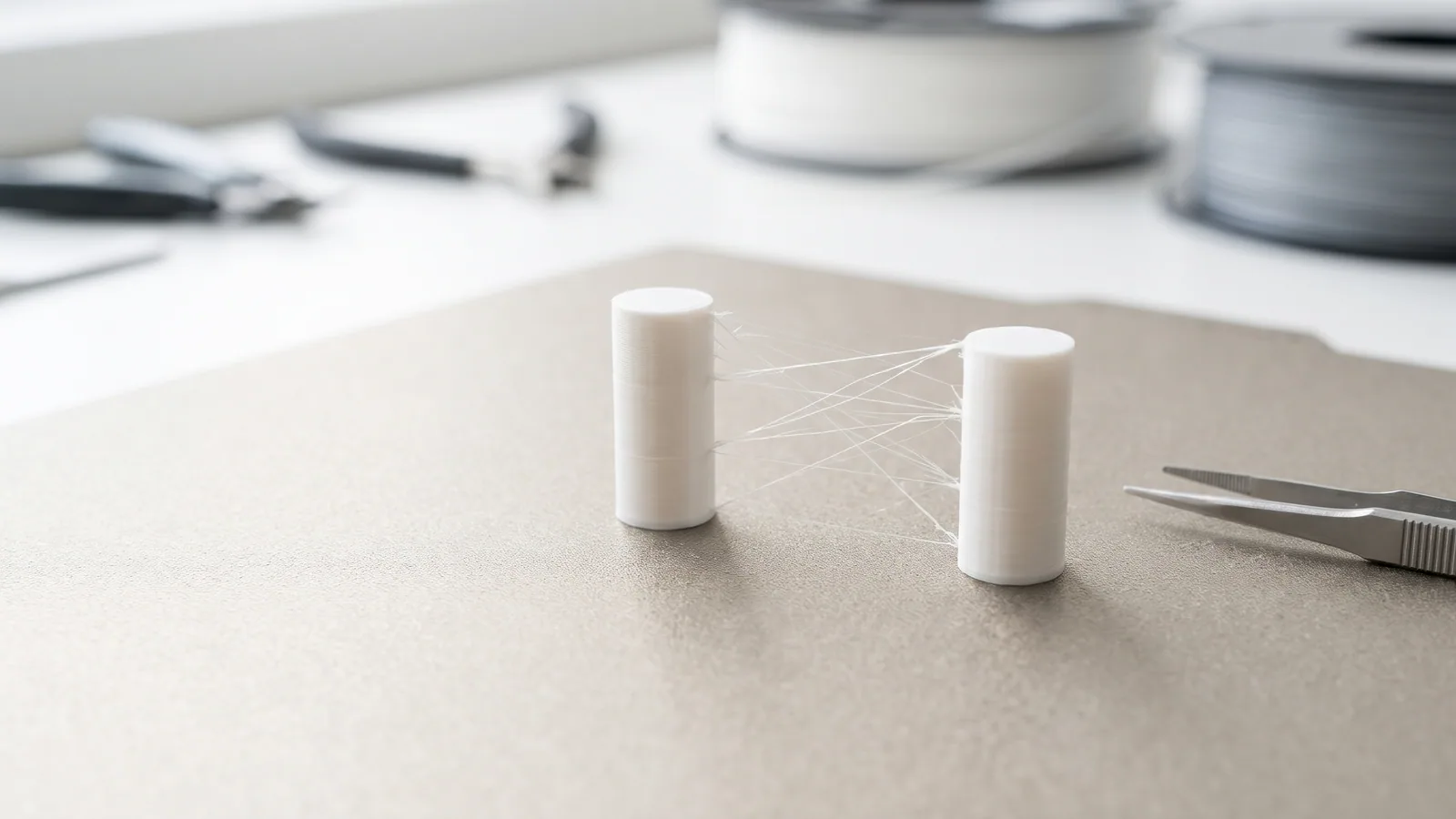
Your printer was fine last month. Now the nozzle crackles, thin hairs of plastic hang between every part, and the top of a print that used to come out smooth looks rough and bubbly. Nothing in the settings changed. The spool did: it has been soaking up water from the air.
This guide shows how to tell when filament is wet, how to dry it with the gear you already have (and what to avoid), and how to keep it dry afterwards. The temperatures come from Bambu Lab's and Prusa's own drying tables, not guesswork. If you print our ready-to-print designs, almost all of them are saved for plain PLA, so the PLA numbers are the ones you will use most.
Why does filament get wet?
Most 3D printing plastics are hygroscopic, a word that just means they pull moisture out of the air. A spool sitting open on a shelf slowly takes on water, and the more humid the room and the longer it sits out, the more it takes on. You cannot see it, and the spool feels exactly the same.
The trouble starts in the nozzle. At printing heat, the water trapped in the plastic turns to steam in an instant. Bambu Lab's guide explains that the steam makes the molten plastic expand and push out unevenly, which shows up as stringing, oozing, rough surfaces, small holes and weaker layers. In bad cases it can also clog the nozzle or cause feeding problems.
Some plastics care more than others. Prusa's knowledge base notes that PLA does not change its properties much when it takes on humidity, while nylon is affected badly. Bambu lists TPU, PETG, PLA Wood, PC and PVA among the plastics it calls hygroscopic. So a PLA spool can often sit out for weeks before you notice anything, while a PETG or TPU spool can start misbehaving much sooner.
How do you tell if filament is wet?
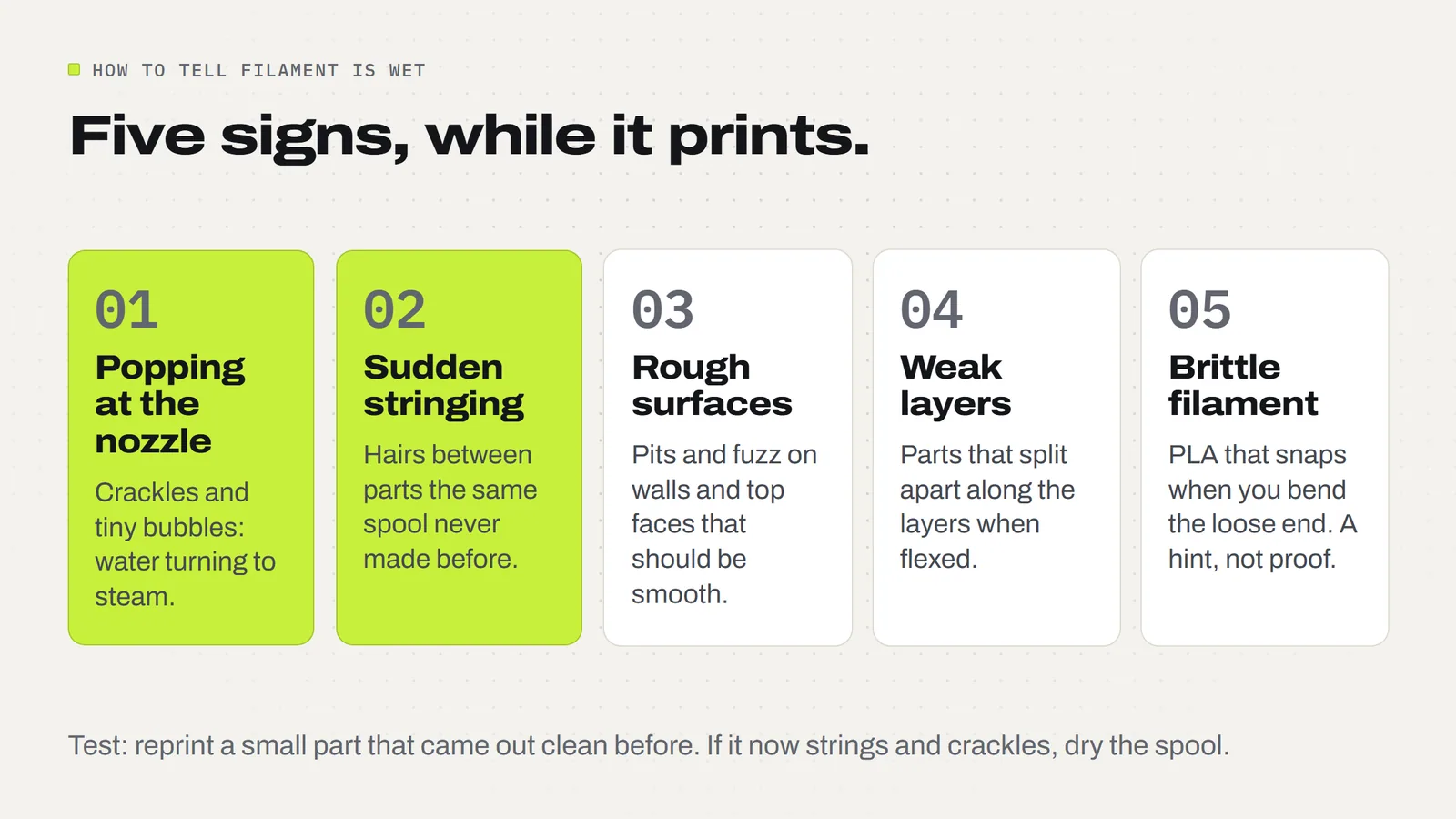
You rarely need a meter. Wet filament gives itself away while it prints. These are the signs, roughly in the order most people notice them:
- Popping or crackling from the nozzle. That is steam escaping. Bambu lists popping sounds and bubbles during extrusion first among its reasons to dry.
- Much more stringing than usual. Fine hairs between parts that a spool from the same box never made before. If you have already worked through our stringing guide and nothing helps, suspect moisture.
- Rough, fuzzy or pitted surfaces. Tiny bubbles and holes on walls that should be smooth, especially on large flat areas and top faces.
- Weak parts. Layers that split apart when you flex a print, or a print that feels weaker than it should.
- Brittle filament on the spool. PLA that snaps when you bend the loose end, rather than bending first. This one is common with old PLA, but brittleness can have other causes too, so treat it as a hint, not proof.
Quick test: print a small part you have printed well before with the same settings. If it now strings and crackles, and a fresh or freshly dried spool prints it clean, the old spool is wet.
How do you dry filament?
Drying means holding the spool at a warm, steady temperature for several hours so the water slowly leaves the plastic. The catch is that the temperature must stay below the point where the plastic softens, or the coils fuse into a solid lump. That is why every method comes down to two numbers: how hot and how long.
There are five common ways to do it. In rough order from most reliable to riskiest:
- A filament dryer. A small heated box made for one or two spools, often with a slot so you can print straight out of it. It is the simplest choice if you print often.
- A drying AMS. Bambu Lab's AMS 2 Pro and AMS HT have drying built in. Bambu gives a maximum drying temperature of 65 °C for the AMS 2 Pro and 85 °C for the AMS HT. Bambu's drying guide lists these two and the AMS 3H; other AMS units are not on it.
- A food dehydrator. Take out the trays and a spool often fits inside. Prusa points out that these usually only reach low temperatures, so check that yours goes high enough for your plastic before you buy one.
- Your printer's heated bed. Only on an enclosed printer, with the spool covered by its box. Bambu says open-frame printers such as the A1, A1 mini and P1P cannot dry filament on the bed.
- A kitchen oven. Possible, but the least safe. See the oven section below before you try it.
Whatever you use, Bambu's advice for afterwards is the same: let the spool cool for 5 to 10 minutes, then put it straight into a sealed box or the AMS with fresh desiccant, and use it soon.
What temperature and how long should you dry filament?
Here are the published numbers from the two makers that test this the most. Bambu's figures are for its own filaments; Prusa's are for its Prusament range. Both are a safe starting point for other brands of the same plastic, and the spool label wins if it says something different.
| Plastic | Bambu, AMS 2 Pro | Bambu, convection oven | Prusa (dryer or oven) | How much it cares |
|---|---|---|---|---|
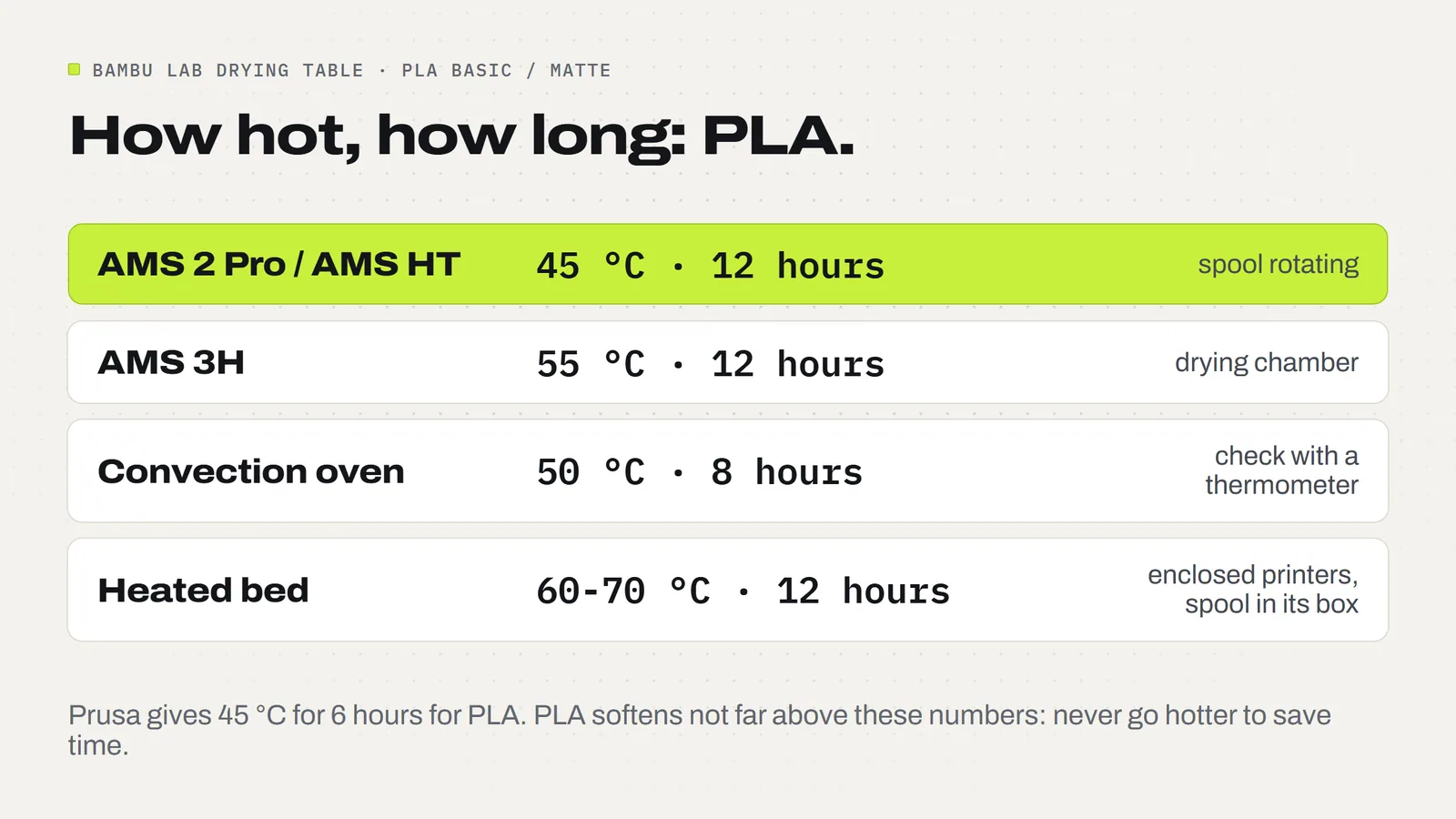
| PLA (Basic, Matte) | 45 °C, 12 hours | 50 °C, 8 hours | 45 °C, 6 hours | Least. Dry when it misbehaves. |
| PLA Silk | 45 °C, 12 hours | 55 °C, 8 hours | not listed | Low |
| PETG | 65 °C, 8 hours | 60-65 °C, 8 hours | 55 °C, 6 hours | Medium. Bambu recommends drying. |
| TPU (flexible) | 65 °C, 12 hours (may not fully dry) | 70 °C, 8 hours | 60 °C, 4-6 hours | High. Bambu says drying is required. |
Two things stand out. First, the makers do not agree to the degree, and that is fine: lower and longer is gentler, higher and shorter is quicker. Anything in these ranges works. Second, PLA's numbers are low for a reason. PLA starts to soften not far above them, which is why going hotter to save time is the most common way people ruin a spool.
Bambu's own PLA Basic data sheet gives a slightly different figure again, 55 °C for 8 hours, for a dedicated dryer. If your dryer has a PLA preset, use it.
Can you dry filament in an oven?
You can, but a kitchen oven is the riskiest way to do it. Prusa gives two reasons. Home ovens do not measure temperature very precisely, and swings that do nothing to a casserole can soften a spool. And many home ovens cannot be set low enough to dry filament without damaging it at all.
If you still want to try:
- Put an oven thermometer next to the spool and check it reads what you set, before the spool goes in.
- If the oven's lowest setting is hotter than the table above, do not use it for PLA.
- Check the spool itself. Bambu notes that some third-party and 3D printed spools may not withstand high temperatures, and rates its own spools at either 70 °C or 90 °C.
- Stay home and check on it. Never leave an oven running overnight with a spool inside.
When Bambu's table says "convection oven", it means one with a fan and an accurate thermostat. A dedicated filament dryer costs less than a ruined batch of prints and does not tie up the kitchen.
Can you dry filament in the AMS?
Only in a model with drying built in: the AMS 2 Pro, the AMS HT or the AMS 3H. They heat the spools and circulate the air, and you can start drying from the printer screen. On supported printers you can also start it remotely from Bambu Studio or the Bambu Handy app.
Three things from Bambu's guide are worth knowing:
- Let PLA spin. Bambu recommends rotating drying, where you pull the filament end out of the feed slot and the spool turns a little every few minutes. It says not to dry PLA, PVA or TPU in static mode (the spool kept still), because they can stick together, swell or deform.
- Do not mix hot and cool plastics. If you dry PETG at its higher temperature, take PLA and TPU out first or they will soften. Drying PLA is fine with other spools still loaded.
- You can print while it dries. The AMS lowers the temperature automatically to protect the softest plastic inside. Bambu's example is PETG drying while PLA prints, which drops to 45 °C.
If you are still deciding whether you need an AMS at all, our AMS guide covers which designs actually need one.
How many spools does a multicolor print keep open?
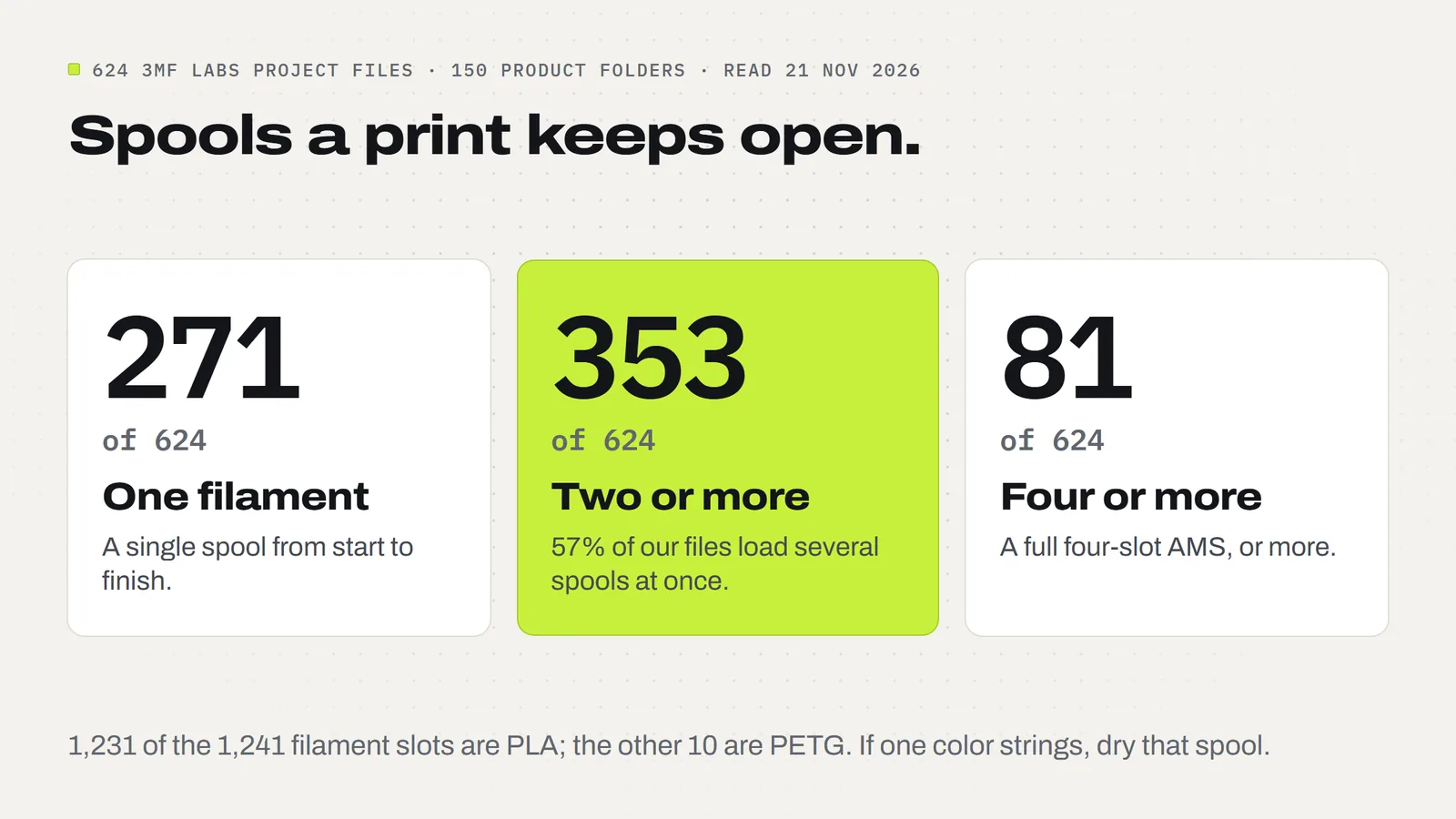
This matters because every spool sitting in an AMS or on a holder is open to the room. We read the saved settings in all 624 Bambu Studio project files behind our 150 product folders (21 November 2026) and counted how many filaments each one is set up with:
- 271 files (43%) are set up with one filament.
- 353 files (57%) are set up with two or more.
- 81 files are set up with four or more, a full four-slot AMS or more.
- 1,231 of the 1,241 filament slots are PLA; the other 10 are PETG.
So a typical multicolor design keeps two to four spools loaded at once. That is fine with PLA, which forgives a damp room better than most plastics. But if one color starts stringing and the others do not, it is usually that one spool, the one that sat out longest, that needs drying. You do not have to dry the lot.
How do you keep filament dry after drying?
Drying is wasted if the spool goes straight back on an open shelf. The fix is cheap:
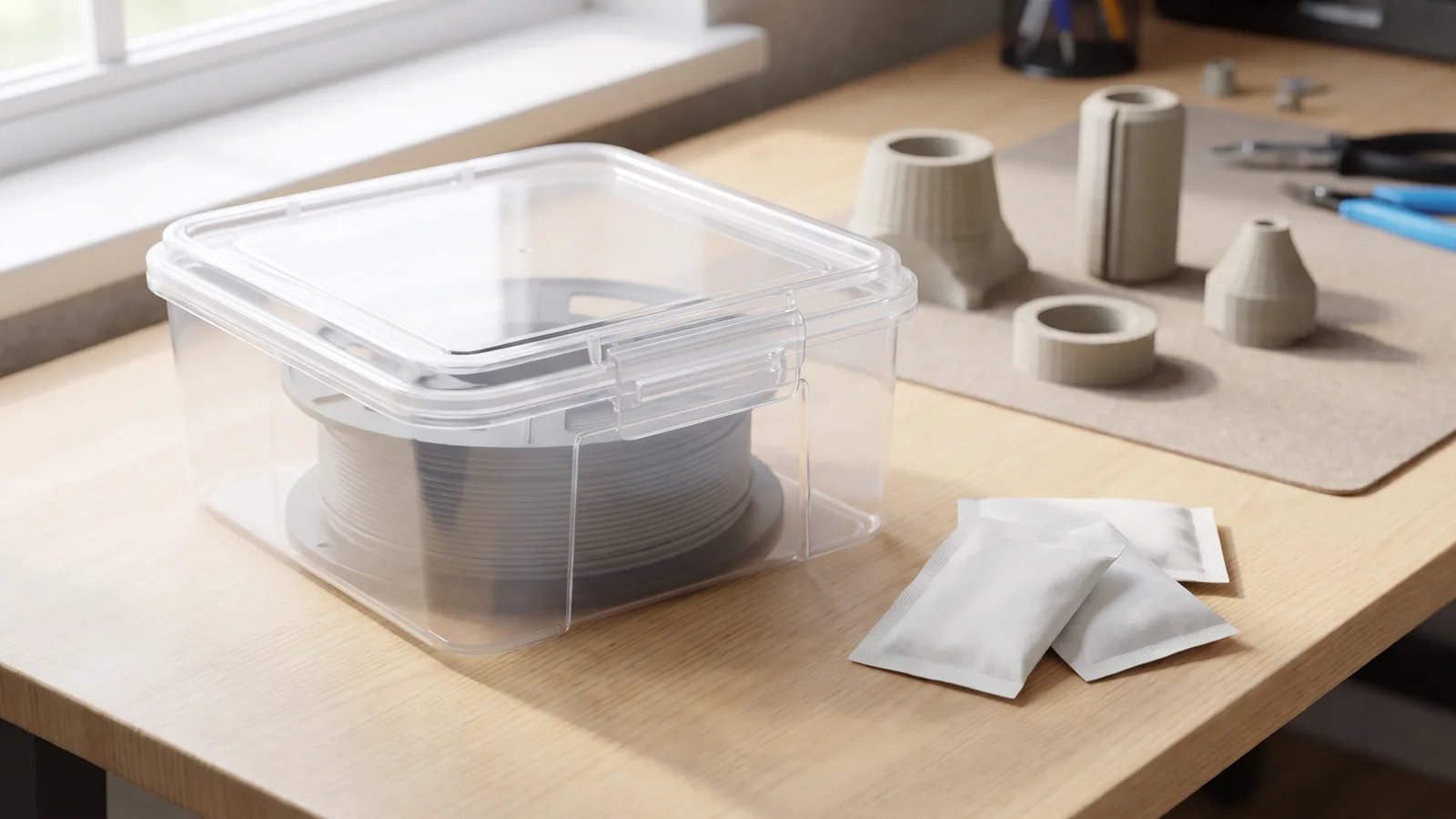
- Seal it. A zip bag with the air pressed out, a vacuum bag, or a plastic box with a gasket lid. Bambu's PLA Basic data sheet says to store it sealed below 20% humidity.
- Add desiccant. Silica gel packs soak up the moisture that gets in. Many packs change color when they are full; dry them out or replace them.
- Keep the box it came in. The original bag and desiccant pack still work if you reseal them.
- Load only what you are printing. Spools that sit in an unheated AMS for weeks take on moisture like any open spool.
- Add a cheap hygrometer. A small humidity gauge in the box tells you when the desiccant is spent.
Do you always need to dry filament?
No. A new spool straight out of its sealed bag is normally dry enough to print. For PLA in particular, plenty of makers never dry at all and only reach for the dryer when a spool starts popping or stringing.
Dry first when the spool has been open a long time, when you live somewhere humid, when you are printing PETG or TPU, or when the print matters: a gift, something for a craft fair table, or a design with large smooth faces where bubbles show. Bambu also recommends drying before prints where looks, accuracy or strength matter.
And if a print still strings after drying, look at temperature next. Our PLA temperature guide covers how hot to run it, and PLA vs PETG explains why PETG strings more no matter what.
The short version
Wet filament crackles, strings and prints rough. Dry PLA at 45 to 55 °C for 6 to 12 hours, PETG at 55 to 65 °C, and TPU warmer and longer. A filament dryer or a drying AMS is the easy way; a kitchen oven is the risky one. Then seal the spool with desiccant. When it prints clean again, pick something worth the spool from our designs: each one opens in Bambu Studio with the plates, colors and settings already saved. New to the format? Start with what a 3MF file is.
Designs from this guide
 $3.79
3ML-143 · Tealight holders
Winter Village Glow Globes
Three white globes with a snowy village raised all the way around. Each one sits over a battery LED tealight: the thin wall glows, the village shows as a silhouette, and the windows and stars shine brightest. STL + 3MF · 11 MB View model $3.79
3ML-149 · Coaster set
Snowflake Coaster Set
Six icy blue drink coasters, each with a different white snowflake, and an open-front holder that stacks all six. Winter decor that stays out after Christmas. STL + 3MF · 6.2 MB View model $2.49
3ML-045 · Light clips
Christmas Light Clips
Four one-piece clips for hanging outdoor string lights on gutters, shingles and round porch rails, with no nails, screws or tools. STL + 3MF · 6.2 MB View model $2.49
3ML-127 · Fidget spinner
Heart Fidget Spinner
Five red hearts that spin around a centre hub, with a little white heart on each. It prints in place in one piece: no metal bearing, no assembly. STL + 3MF · 4.3 MB View model $5.99
3ML-134 · Snap-together toy truck
Monster Truck
A big snap-together monster truck with a square pickup body, a roll cage and race seat inside, and four huge tyres that turn. 20 pieces, no glue, no screws, no AMS. STL + 3MF · 9.1 MB View modelQuestions
How do I know if my filament is wet?
Listen and look while it prints. Popping or crackling from the nozzle, much more stringing than usual, rough or bubbly surfaces and weak layers are the usual signs. PLA that snaps when you bend the loose end is another hint. Reprint a small part that used to come out clean: if it now strings, dry the spool.
What temperature do you dry PLA at?
Low. Bambu Lab gives 45 °C for 12 hours in the AMS 2 Pro and 50 °C for 8 hours in a convection oven for its PLA Basic. Prusa gives 45 °C for 6 hours. PLA softens not far above these numbers, so do not go hotter to save time.
How long does it take to dry filament?
Usually 6 to 12 hours. Prusa lists 6 hours for PLA and PETG and 4 to 6 hours for TPU. Bambu's table runs longer and gentler: 8 to 12 hours for PLA, 8 hours for PETG and 12 to 18 hours for TPU depending on the method.
Can I dry filament in my kitchen oven?
You can, but it is the riskiest method. Prusa notes that home ovens do not hold temperature precisely and that many cannot be set low enough for filament at all. If you try, check the real temperature with an oven thermometer first, make sure the spool can take the heat and do not leave it unattended.
Can the Bambu AMS dry filament?
Only the models with drying built in. Bambu gives a maximum drying temperature of 65 °C for the AMS 2 Pro and 85 °C for the AMS HT, and also lists the AMS 3H. For PLA, Bambu recommends rotating drying, with the filament end pulled out so the spool can turn.
Does new filament need to be dried?
Usually not. A spool straight out of its sealed bag with desiccant is normally dry enough to print. Dry it first if the bag was damaged, if the spool sat open, or if you are printing something where surface quality or strength really matters.
Does PLA absorb moisture?
Yes, but less than most plastics, and it suffers less. Prusa notes that PLA does not change its properties much when it takes on humidity, while nylon is affected badly. PETG and TPU need drying more often than PLA.
How should I store filament?
Sealed, with desiccant. A zip bag with the air pressed out or a box with a gasket lid both work. Bambu's PLA Basic data sheet says to store it below 20% humidity. A cheap hygrometer in the box tells you when the silica gel needs drying or replacing.
Sources
Filed under Printing and slicing